
Tenerife is the largest of the Canary Islands and sits 300 kilometres off the coast of West Africa, geologically part of Spain, climatically part of the Atlantic tropics, and culinarily something entirely its own. The island’s food culture has been shaped by its volcanic soil, its altitude (Teide, the highest point in Spain, reaches 3,718 metres), its Atlantic fishing tradition, and centuries of interchange between Spain, Africa, and the Americas.
The result is a food culture that shares almost nothing with mainland Spanish cooking and is one of the most underexplored regional cuisines in the country.
The volcanic soil and what it produces
Tenerife’s volcanic soil — specifically the porous, mineral-rich lapilli (volcanic ash particles, called picón locally) of the north and northeast — produces agricultural conditions that do not exist anywhere else in Spain. The wine grapes grown in these soils produce wines of exceptional mineral character. The potatoes grown here are varieties that existed before the industrial standardisation of agriculture. The tomatoes, peppers, and subtropical fruits grown on the southern and western slopes in the warm microclimate produce flavours of uncommon intensity.
The island’s altitude creates multiple microclimates within a small area: the south is arid and warm year-round, suitable for banana cultivation and tourism; the north is humid and green, suitable for wine and agriculture; the high interior around Teide is cold enough for frost. A single island produces the full range of Spanish agricultural produce in miniature.
Papas arrugadas
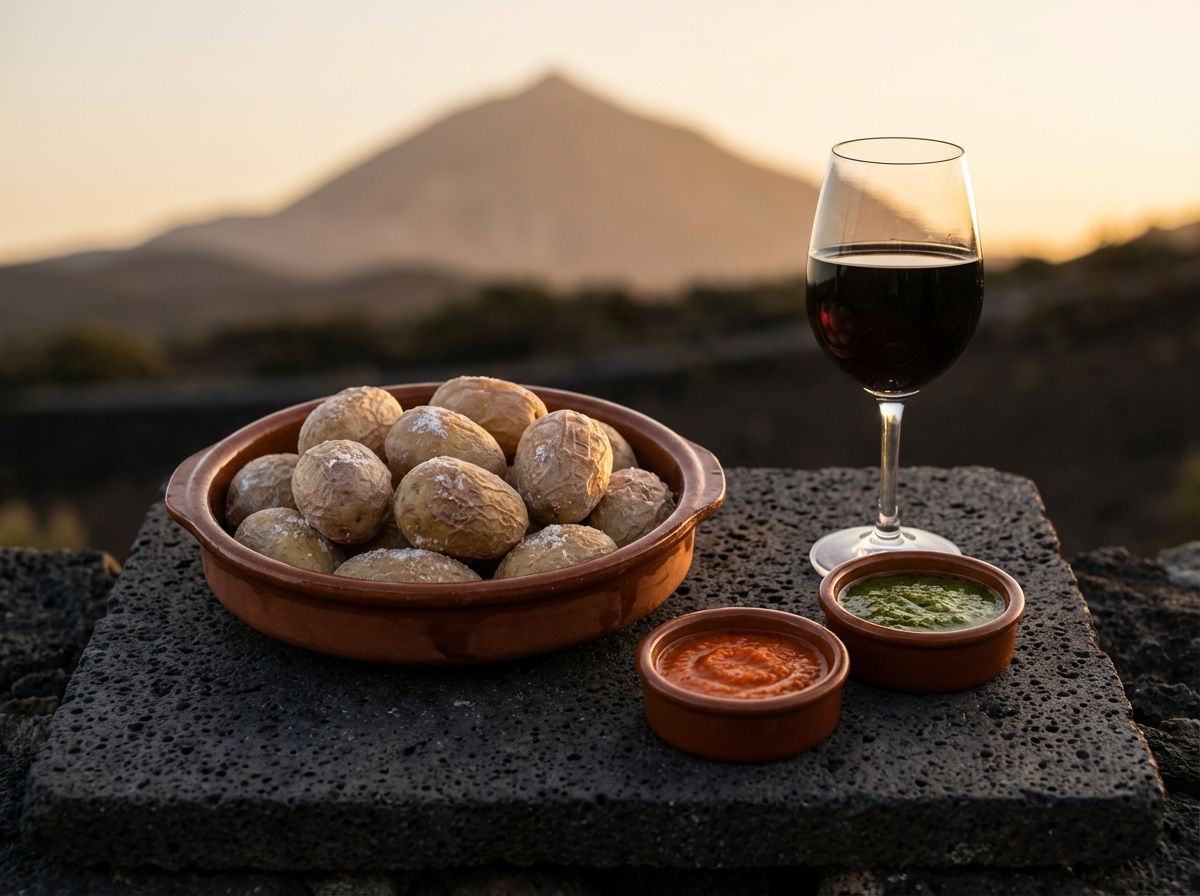
The most important potato dish in the Canaries. Small, wrinkled potatoes (papas arrugadas means “wrinkled potatoes”) boiled in heavily salted water until the water evaporates and the salt crystals form on the skin. The potatoes are served whole, skin on, warm, with mojo sauce.
The potato varieties used for papas arrugadas are Canarian heritage varieties — papa bonita, papa negra, papa colorada — that are grown specifically on the islands and are not found on the mainland. The texture is creamier and the flavour is more complex than any supermarket potato. A bowl of papas arrugadas with both mojos costs €4 to €7 and is available at every local restaurant on the island.
Mojo
Mojo is the defining sauce of Canarian cooking. There are two canonical versions, served together with papas arrugadas.
Mojo rojo (red mojo): Made from dried red peppers (ñora or other Canarian varieties), garlic, cumin, olive oil, vinegar, and salt. The colour is deep orange-red and the flavour is smoky, garlicky, and mildly spicy. The texture should be a rough paste, not a smooth purée — mojo is ground in a mortar, not blended.
Mojo verde (green mojo): Made from fresh coriander or parsley, garlic, cumin, olive oil, and vinegar. The colour is bright green and the flavour is herbal and sharp. Mojo verde is specifically associated with fish in Canarian cooking — it is the sauce served with grilled fish throughout the islands.
Both mojos are made fresh in traditional households and at good restaurants. Factory-bottled mojo is available in supermarkets and is acceptable but noticeably inferior to fresh. If a restaurant serves mojo that tastes of vinegar and little else, the jar has been on the shelf too long.
Ropa vieja canaria
Not to be confused with the Cuban ropa vieja (shredded beef). Canarian ropa vieja is a chickpea and shredded chicken stew, slow-cooked with tomato, saffron, and ñora pepper. The name (“old clothes”) refers to the shredded texture of the chicken. It is a dish of Moorish and Atlantic interchange — the chickpea tradition from Andalucia, the ñora pepper from the Americas via the Canary Islands, which were a stopping point for the return journeys of the Spanish galleons.
Ropa vieja canaria is one of the best stews in Spain and is almost entirely unknown outside the islands. It is available at local restaurants in every town and village, costs €8 to €12 per portion, and is the dish that most visitors to Tenerife discover and spend the rest of their lives trying to recreate at home.
Canarian wines
Tenerife has five DO (Denominación de Origen) wine regions — more than any other single island in the world. The vine-growing areas range from the warm south (DO Abona) to the cool, humid north (DO Valle de la Orotava and DO Tacoronte-Acentejo) to the high-altitude interior (DO Güímar). The combination of ancient vine varieties (listán negro, listán blanco, negramoll, marmajuelo) grown in volcanic soils at various altitudes produces wines of unusual character.
Listán negro is the primary red variety — producing wines of medium body, high natural acidity, and mineral, earthy flavour that are unlike any mainland Spanish red. Listán blanco produces whites of bright acidity with stone fruit and saline notes. The volcanic soil contributes a specific mineral quality that is immediately recognisable.
The best wines come from the north: Bodegas Monje in El Sauzal, Suertes del Marqués in La Orotava valley, and Envínate (whose Tenerife wines are among the most discussed in the natural wine world) are the producers most worth seeking out. A good bottle of Tenerife wine costs €12 to €25 at the producer and is significantly cheaper than the equivalent quality from mainland Spain.
Where to eat well in Tenerife
La Laguna: The island’s university city and cultural capital, in the north. The best local eating on the island is concentrated here — traditional Canarian restaurants serving papas arrugadas, ropa vieja, and gofio (toasted grain flour used in porridge and as a thickener) at local prices. Avoid the tourist strip in Puerto de la Cruz and eat in La Laguna instead.
La Orotava: In the fertile valley below Teide, one of the most beautiful towns on the island. Several restaurants serve Canarian cooking using produce from the valley’s farms. The valley is also the wine country — visit the bodegas in the morning and eat lunch in town.
El Médano: A windsurfing town on the southern coast with a more authentic local character than the major resort areas. The fish restaurants here serve the day’s catch at normal prices.
Frequently asked questions
What is the traditional food of Tenerife?
Papas arrugadas with mojo rojo and mojo verde is the most iconic dish. Ropa vieja canaria (chickpea and shredded chicken stew) and gofio (toasted grain flour in various preparations) are the other distinctly Canarian dishes. The food owes more to the Atlantic trade routes and African proximity than to mainland Spanish cooking.
What is gofio?
Gofio is toasted grain flour — made from wheat, maize, or a blend — that has been a staple food on the Canary Islands since the pre-Spanish Guanche inhabitants. It is used as a porridge (amasado), mixed into stews as a thickener, added to fish stock as an escaldón, and eaten as a sweet with honey and almonds. It is the most distinctly Canarian food product and is not found in mainland Spain.
Is Tenerife wine worth drinking?
Yes — emphatically. The volcanic soil and ancient vine varieties of Tenerife produce wines that are genuinely different from any mainland Spanish wine. The listán negro reds and listán blanco whites from the north of the island are among the most distinctive wines in Spain. Seek out Suertes del Marqués and Envínate if you can find them outside the island; buy Bodegas Monje directly at the winery.
More island food? Read our guide to Menorca’s lobster coast and eating well in Mallorca.
Found a correction or an update?
Email us at hello@spainfoodguide.com — we keep our entries current.
Run a restaurant in Spain you think we should know?
Get featured →