
Menorca is the quietest of the four major Balearic Islands and has the most intact local food culture. While Ibiza built an identity around nightlife and Mallorca built one around mass tourism, Menorca developed at a different pace — its UNESCO Biosphere Reserve status since 1993 has slowed development and preserved an agricultural and maritime landscape that produces food of genuine quality.
The island’s most celebrated dish is caldereta de llagosta: Menorcan lobster stew. It is expensive, specific to the island, and worth planning a meal around if you are visiting between May and August when the spiny lobster (llagosta in Catalan; langosta in Castilian) is in season.
Caldereta de llagosta
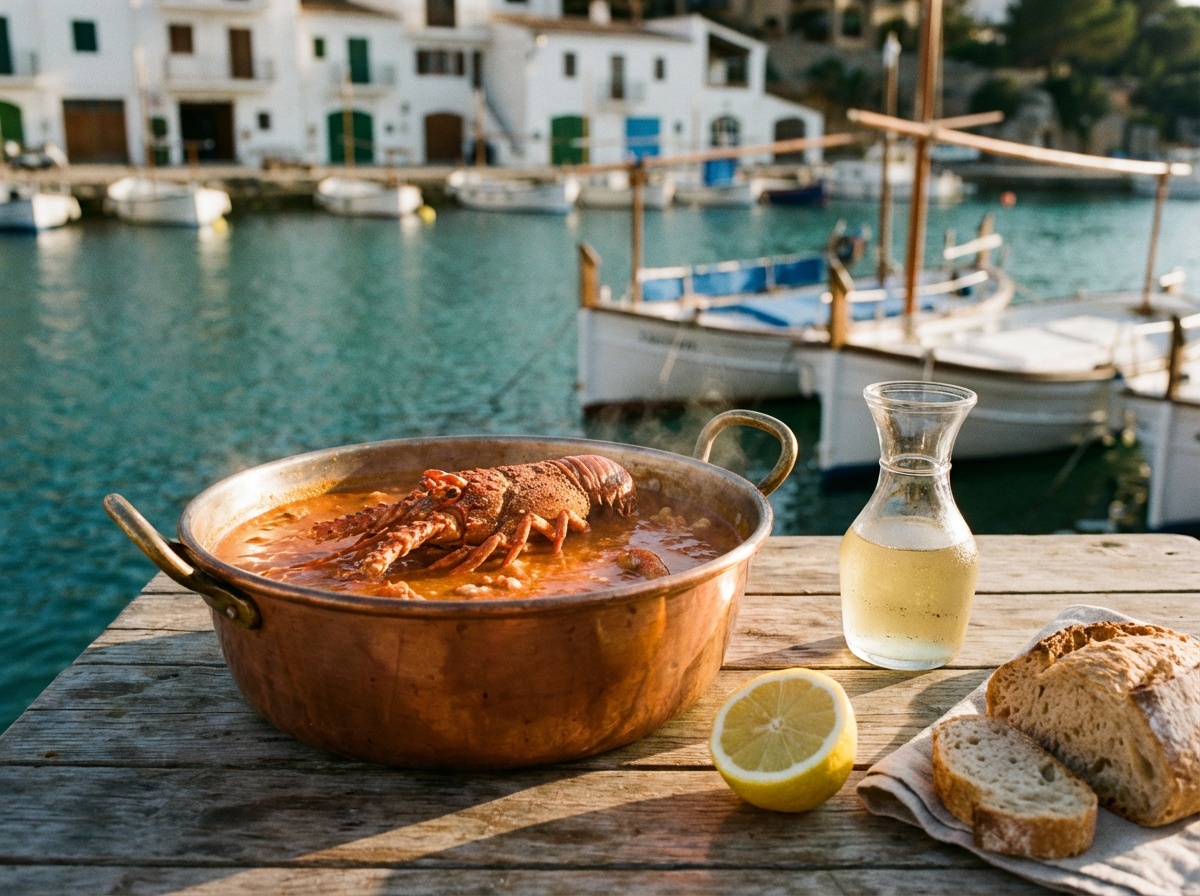
Caldereta de llagosta is a slow-cooked stew made with locally caught spiny lobster in a base of tomato, onion, garlic, brandy, and the ground livers and roe of the lobster itself. The ground organs thicken the broth and give it an intense, almost bisque-like richness. The lobster is cut into sections, briefly sautéed, and finished in the broth. The dish is served with pan moreno (Menorcan dark bread) for mopping the sauce.
The version considered definitive is from the fishing ports on the north coast of the island — Fornells, on the deep inlet of the same name, is the village most associated with the dish. The fishing boats from Fornells catch spiny lobster in the rocky waters around the northern headlands, and the village’s restaurants have been cooking caldereta since the early 20th century.
The price reflects the cost of the ingredient: caldereta de llagosta for two costs €80 to €150 depending on the restaurant and the size of the lobster. This is not a dish to order without checking the market price, which changes daily based on the catch. Most restaurants in Fornells display the daily lobster price on a chalkboard outside.
Where to eat caldereta in Fornells:
Es Pla: One of the long-established restaurants in Fornells, on the harbour front. The caldereta here is made in the traditional style with local lobster. Book for dinner at least two days in advance in July and August.
La Palma: Opposite the harbour, with an outdoor terrace directly on the water. The caldereta is excellent and the setting — lobster boats visible from the table — is appropriately contextual. Slightly more relaxed than Es Pla in atmosphere.
Sa Llagosta: Named for the lobster, the village’s oldest caldereta restaurant. The preparation is the most traditional version available in Fornells, cooked in a cazuela (earthenware pot) over an open flame.
The north coast fishing ports
Fornells is the anchor but the north coast has other fishing ports worth visiting for simpler, cheaper fish eating. Cala Morell, in the far northwest, has a small harbour with a bar that buys directly from the local boats and serves grilled fish — dorada (sea bream), lubina (sea bass), mero (grouper) — at prices that reflect the short supply chain.
The north coast is the wilder, less developed side of the island. The road along the tramuntana (north-facing coastal cliffs) is unpaved in sections and most of the coves are accessible only on foot or by boat. The beaches are emptier and the fishing villages have not been converted into tourist infrastructure. This is where to go for the island that existed before package tourism.
Menorcan cheese: Mahón-Menorca
Mahón-Menorca is one of Spain’s most important cheese DOs. Made from pasteurised or unpasteurised cow’s milk (the unpasteurised artisan version is significantly better), it is a pressed, semi-hard cheese with a characteristic square shape from the traditional wrapping in cloth during pressing. The rind is rubbed with butter, oil, and paprika during curing, which gives the exterior its orange-brown colour.
The cheese is sold at four ageing stages: tiern (fresh, 10 days minimum), semi-curado (2-5 months), curado (5-10 months), and añejo (over 10 months). The añejo is the most complex, with a sharp, crystalline texture and concentrated flavour. It pairs exceptionally well with the island’s Gin de Menorca (see below) and with honey from the island’s beekeeping tradition.
Buy it directly from the farms (ateliers) in the agricultural interior — the road between Maó and Ciutadella passes several farms that sell from the door — or from the market in Maó (Es Claustre market, Saturday mornings).
Gin de Menorca
Menorca has a gin tradition that predates the current global gin revival by two centuries. The British occupied the island from 1708 to 1802 (with interruptions) and left behind a gin-drinking culture that persists. The island’s gin, called gin de Menorca or simply gin de Mao (from the capital Maó), is a juniper-forward, slightly sweet London Dry-style spirit produced by a single distillery, Xoriguer, that has been making it since the 18th century.
The local way to drink it: pomada, which is gin de Menorca mixed with lemon granita or lemon soda in a ratio of approximately one part gin to three parts lemon. It is the island’s version of rebujito — the drink specifically associated with local festas and summer eating. A glass of pomada costs €3 to €5 at any bar on the island.
The interior: ensaïmades and sobrassada
The agricultural interior of Menorca, between Maó and Ciutadella, produces some of the best ensaïmades (the Balearic spiral pastry) and sobrassada (the paprika-cured spreadable sausage) outside Mallorca. The Saturday market in Maó (Es Claustre) is the best single place to buy both, alongside the Mahón-Menorca cheese.
Sobrassada on Menorca is made from local black pig (porc negre) and is noticeably more complex than the commercial versions exported from Mallorca. Spread on warm bread with honey, it is the correct Menorcan breakfast.
When to visit for food
The lobster season runs from May to August. Outside this window, caldereta de llagosta is either unavailable or made from frozen lobster at restaurants that do not announce the substitution. For the real dish, visit in June or July when the catch is at its peak and the prices are most competitive.
The island is significantly less crowded in May, early June, and September than in July and August. The food quality does not drop in the shoulder season — the fish markets and the agricultural produce are at their best in late spring and early autumn.
Frequently asked questions
What is the most famous food from Menorca?
Caldereta de llagosta (spiny lobster stew) is the island’s signature dish. Mahón-Menorca cheese is the most internationally recognised product. Sobrassada from the local black pig and gin de Menorca (Xoriguer) are the other distinctly Menorcan food products.
Is mayonnaise from Menorca?
Possibly. The claim that salsa mahonesa (mayonnaise) was invented in Maó during the French occupation of the 18th century is plausible but contested by French food historians. The island does make and consume large quantities of aioli and mayonnaise, and the Maó origin story has enough historical basis to be worth repeating at the table.
How expensive is food in Menorca?
For everyday eating — market produce, bar lunches, local restaurants — Menorca is comparable to mainland Spain. The caldereta de llagosta is expensive wherever you eat it because the ingredient is expensive. Budget €60 to €80 per person for a caldereta meal with wine. Everything else is normal Spanish prices.
More Balearic Islands food? Read our guide to eating well in Ibiza beyond the clubs and where to eat in Mallorca.
Found a correction or an update?
Email us at hello@spainfoodguide.com — we keep our entries current.
Run a restaurant in Spain you think we should know?
Get featured →