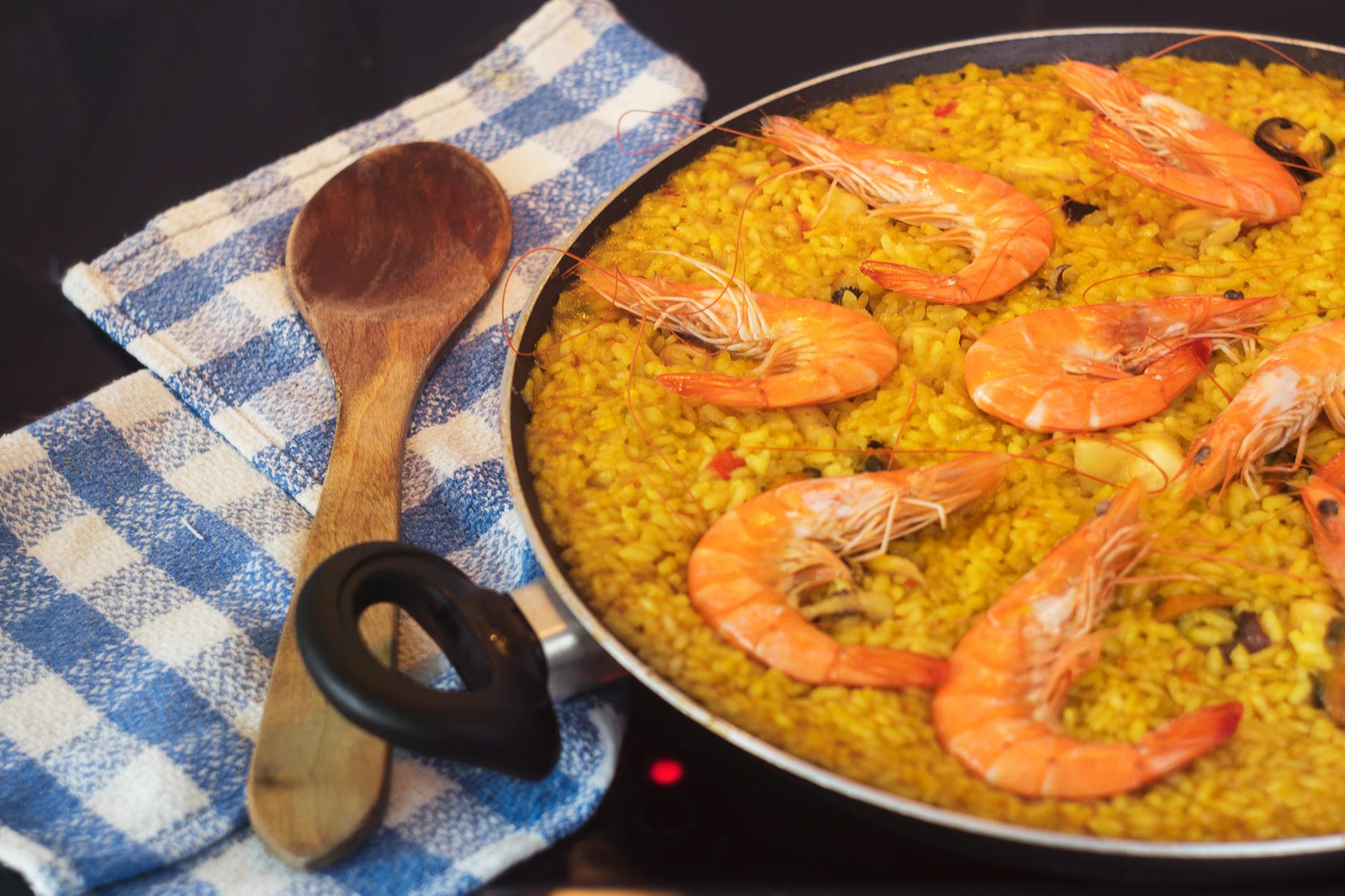

Valencian paella is one of the most misrepresented dishes in the world. Abroad, “paella” has come to mean almost any Spanish rice dish cooked in a wide pan, frequently containing seafood, often with chorizo added, and produced in quantities designed to feed a crowd at a party. None of these things are the Valencian original.
This guide explains what authentic Valencian paella actually is, how to cook it correctly, and why the dish that most people have eaten is something different.
What Valencian paella is
Valencian paella is a rice dish cooked in a wide, shallow pan (also called a paella or paellera) over an open wood fire, made with specific ingredients native to the Valencia region. The canonical ingredients of paella valenciana are:
- Round-grain rice (varieties: Senia, Bomba, Albufera — all from the Valencia rice-growing area around the Albufera lagoon)
- Chicken (rabbit is also traditional; snails in the most traditional versions)
- Ferraura (flat green beans, also called bajoca)
- Garrofó (a large flat white bean specific to Valencia, similar to a butter bean)
- Tomato (ripe, grated or roughly chopped)
- Olive oil
- Saffron
- Paprika (pimentón dulce)
- Water
- Salt
- Rosemary (optional, placed on top during the final cooking stage)
There is no seafood in traditional paella valenciana. There is no chorizo. There is no onion, no garlic (beyond what is in the sofrito), no peas, no peppers. These ingredients appear in other rice dishes — arròs a banda, arròs negre, arròs amb fesols i naps — but not in the Valencian original.
The cooking method
Valencian paella is cooked outdoors over a wood fire of orange wood, which is the traditional fuel source in the orange-growing region around Valencia. The fire burns under the pan and the cook controls the heat by adjusting the wood position rather than a gas dial. This is the traditional method; gas or electric burners produce an acceptable result but a different flavour.
The sofrito: The base of the paella begins with olive oil in the pan. The chicken and rabbit (cut into small pieces) are browned in the oil over high heat. The tomato is added and cooked down into a concentrated paste. The paprika is added briefly — 30 seconds over medium heat — and immediately followed by the water, which prevents the paprika from burning.
The stock: The water, combined with the cooking juices from the meat and the tomato, forms the stock in the pan. The flat green beans and garrofó beans go in at this stage and cook in the stock for 20 to 25 minutes. The saffron is added to the stock. The liquid is seasoned and the volume adjusted — the ratio of water to rice is the most critical variable in paella cooking.
Adding the rice: The rice is added directly to the stock in the pan in a cross pattern, then distributed evenly with a spoon. From this point, the rice is not stirred. This is fundamental — stirring paella releases starch and produces a risotto-like result, not the separate-grained dry finish of a correct paella.
The socarrat: The socarrat is the layer of caramelised, slightly crispy rice at the bottom of the pan, produced by a brief increase in heat at the end of cooking. It is not burned — it is the most prized part of the paella. The socarrat develops when the stock is fully absorbed and the bottom of the rice is in direct contact with the hot oil left in the pan. A good socarrat smells of toasted rice, not smoke.
Resting: The paella rests for 5 minutes after coming off the fire, covered loosely with clean cloth or newspaper. This allows the rice to finish absorbing any remaining moisture.
Rice varieties
Bomba: The most widely available Valencian rice variety outside Spain. A short, round grain that absorbs 2.5 to 3 times its volume in liquid. Bomba is forgiving — it does not overcook easily and maintains its shape under pressure. The standard choice for cooks who are less experienced with paella.
Senia: More absorbent than Bomba (3 to 3.5 times its volume), with a slightly creamier texture and better flavour. Less forgiving — it can overcook quickly if the liquid ratio is off. The preferred rice of experienced paella cooks in Valencia.
Albufera: A hybrid developed in the Valencia research stations, combining the absorbency of Senia with some of the resilience of Bomba. Growing in popularity among professional cooks.
Outside Spain, use Bomba if you can find it (available in specialist food shops and online). Italian Arborio is not a substitute — the grain is too large and the starch content produces the wrong texture.
The water ratio
The ratio of water to rice in paella is approximately 3 to 1 by volume for Bomba, slightly more for Senia. This is not as precise as pasta or risotto — the exact ratio depends on the heat of the fire, the width of the pan, the humidity of the day, and the specific rice batch. Experienced paella cooks adjust by eye and by sound (listening to the boil reduce to a gentle simmer as the rice absorbs the stock).
For a beginner cook: start with 3 parts water to 1 part rice and check the rice frequently after 15 minutes. If the stock has been absorbed and the rice is not yet cooked, add small quantities of hot water. If the rice is cooked and stock remains, increase the heat briefly to evaporate it.
Where to eat authentic paella valenciana
The area around the Albufera lagoon, 15 kilometres south of Valencia city, is where paella was invented and where the most traditional versions are still cooked. The restaurants along the lake — in El Palmar village — cook paella over orange wood fires using locally grown rice and ingredients. This is the most authentic context available.
In Valencia city: La Pepica on the Malvarrosa beach has been cooking paella since 1898 and is the most famous paella restaurant in the city. Casa Carmela on the same beach is another long-established option. Both are considerably better than any paella restaurant in Madrid, Barcelona, or anywhere outside Valencia.
Frequently asked questions
Does paella valenciana have seafood?
No. Traditional paella valenciana contains chicken, rabbit, flat green beans, garrofó beans, tomato, saffron, and rice. Seafood paella (arròs a banda, paella de marisco) is a different dish. The combination of chicken and seafood in the same pan is known in Valencia as paella mixta and is considered a compromise for tourists rather than a traditional dish.
Can you put chorizo in paella?
Not in traditional Valencian paella. Chorizo does not appear in any historical Valencian paella recipe. It is added by non-Spanish cooks and by tourist-facing restaurants abroad. In Valencia, adding chorizo to paella is roughly equivalent to adding ketchup to a risotto — technically possible, not the dish.
What is socarrat?
The caramelised, slightly crispy layer of rice at the bottom of a correctly cooked paella. It forms when the stock is fully absorbed and the rice base is in contact with the hot oil in the pan. The socarrat is the most prized part of the paella and a mark of skilled cooking. It should taste of toasted rice and caramel, not smoke or char.
More Valencian food? Read our guide to 24 hours eating in Valencia and our look at the menú del día explained.
Found a correction or an update?
Email us at hello@spainfoodguide.com — we keep our entries current.
Run a restaurant in Spain you think we should know?
Get featured →