
24 Hours Eating in Valencia
Eating in Valencia means starting early with a two-fisted sandwich, surrendering the middle of the day to a rice pan the size of a bicycle wheel, and finishing with a glass of something cold in a square that has been serving drinks since the 1800s. This is the city that invented paella, exports chufa from the fields just north of it, and runs on a rhythm the rest of Spain only half-copies. A day here is not a parade of tasting menus. It is a slow, specific loop through markets, rice paddies, and old-town bars, timed to the local clock.
Follow this itinerary for one full day of eating in Valencia. Everything is real, everything is walkable or a short taxi away, and every stop has been earning its reputation for at least a generation.
TL;DR: One day of eating in Valencia
- 8am. Almuerzo in Ruzafa: a bocadillo the size of your forearm, an espresso, a small beer.
- 11am. Vermut and anchovies at Central Bar inside the Mercado Central.
- 2pm. Paella valenciana in El Palmar on the edge of the Albufera, cooked over orange wood.
- 5pm. Horchata and fartons at Horchateria Santa Catalina in the old town.
- 8pm. Aperitivo in El Carmen: small plates, cold beer, cobblestones.
- 10pm. Late dinner in Ciutat Vella, ending with a glass of Utiel-Requena red.
Total cost for a careful eater: around 95 to 120 euros. Total walked: roughly nine kilometres, most of it pleasant.
8am: Almuerzo in Ruzafa
The Valencian day does not begin with toast and jam. It begins with the esmorzaret, a second breakfast that doubles as a territorial statement. Between eight and ten, builders, office workers, and retirees file into unglamorous bars and order an enormous sandwich stuffed with whatever the cook has been braising since dawn. There is a beer. There is a small plate of olives and peanuts. There is a cortado to finish. Skip it and you have misunderstood the city.
Ruzafa is where this ritual still runs on local fuel, even as the neighbourhood has become the cocktail-bar-and-vintage-shop “Williamsburg of Valencia”. For a working-class almuerzo, aim for Bar Ricardo on Carrer de Doctor Serrano or La Cantina de Ruzafa just off the Plaza del Barrio del Carmen. Order the blanc i negre (black pudding and white sausage) or the brascada (slow-cooked pork with onion and red pepper). Sandwiches run 6 to 8 euros and arrive on a baguette that has no interest in your jaw.
The rules are not negotiable. A caña of beer, never a glass of water. Cacauets (peanuts) and olives on the table, free. A shot of cremaet, the local coffee-and-rum bomb, if your host insists. Valencians call this a desayuno de campeonato – a champion’s breakfast – and eating it means accepting you will not be hungry again until two.
Finish up, grab a stool outside, and watch Ruzafa wake up. The ornate modernist facade of the Mercado de Ruzafa is across the street. By ten, the flower sellers are unpacking. You are exactly on schedule.
11am: Mercado Central and a vermut
Walk or tram it fifteen minutes north and you arrive at the Mercado Central, a 1928 Art Nouveau cathedral of food with 8,000 square metres of stained glass, iron, and fish counters. It is one of the largest fresh-produce markets in Europe and the beating heart of eating in Valencia. Come here to look, and then come here to drink.
Inside, in stalls 105 to 131, is Central Bar by Ricard Camarena. Camarena holds 11 Michelin stars across his restaurant group, but this little counter under the market’s dome is the democratic version of his kitchen. You stand. You order at the bar. The chef is visible cooking two metres away.
This is vermut o’clock – the Spanish pre-lunch ritual of a glass of red vermouth, an ice cube, a slice of orange, and something salty. Order a vermut de grifo (vermouth on tap) for 3 euros and a plate of salted anchovies from the Cantabrian coast, or the bravas with their famous smoked paprika aioli. A small sandwich of sobrasada and local Manchego costs 6 euros and will calm whatever the almuerzo started.
Do not linger past noon. The market closes at 3pm, and the real lunch is happening eighteen kilometres south.
2pm: Paella on the edge of the Albufera
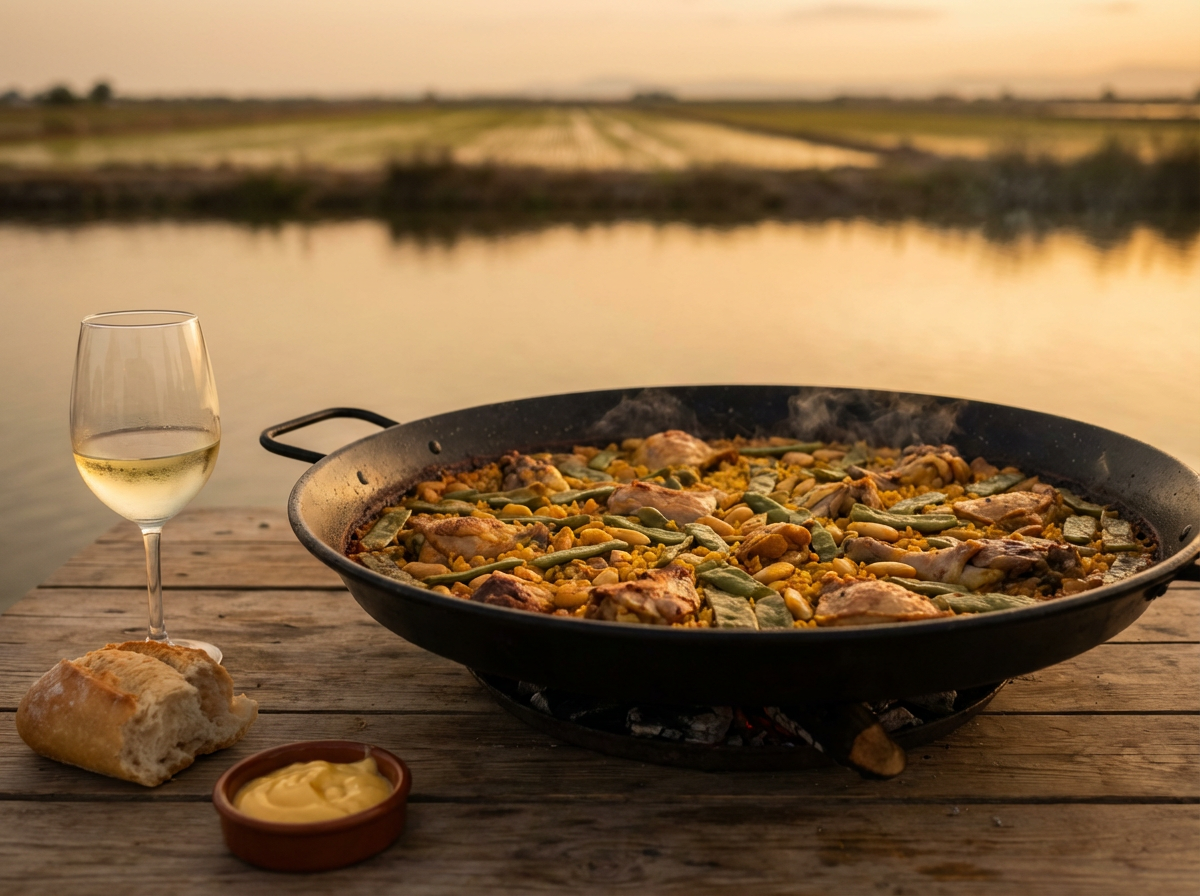
A twenty-minute taxi south, past rice paddies that flash mirror-bright in the sun, drops you in El Palmar. This village of about 800 people sits on an island in the Albufera, the freshwater lagoon where paella valenciana was invented in the 19th century. Eating rice here is not a tourist exercise. It is the source code.
Real paella valenciana is a strict recipe. Chicken, rabbit, garrofo beans, bajoqueta green beans, tomato, saffron, rosemary, bomba rice, water, salt, olive oil, wood. Nothing else. No chorizo, no prawns, no peas. Spanish chefs have gone to war on social media over less. In El Palmar, the village enforces it the way a village enforces things: by refusing to cook it any other way.
Book Arroceria Maribel, which collected a Michelin Bib Gourmand in the 2026 guide released last November. The dining room opens straight onto the lagoon. The paella arrives after 45 minutes of waiting, which is not a delay – it is the cooking time. You will hear the socarrat, the caramelised rice crust at the bottom of the pan, before you see it. Scrape it up. That is the point.
For a more storied room, book Bon Aire, the family-run restaurant open since 1982 that won the Concurso Internacional de Paella Valenciana in 2014 and still cooks over orange wood. Or L’Establiment, also 1982, sitting on the water with reed mats for shade. At any of the three, a paella for two runs 50 to 70 euros, plus a bottle of cold local white – a Merseguera or a young Verdil from the Valencia DO. If you cannot get to El Palmar, the city has one non-negotiable backup: Casa Carmela, a 1922 beachfront institution on Malvarrosa where fourth-generation chef Toni Novo cooks a dozen paellas a day over orange wood. They take lunch reservations only. Book two weeks ahead.
After lunch, walk along the dirt path beside the lagoon. Fishermen will be pulling in eels for tonight’s all i pebre. The afternoon light turns the water the colour of weak tea. You have earned the next stop, which is sugar.
5pm: Horchata and fartons
Back in the city, the merienda – the late-afternoon snack – is a Valencian specialty with its own dedicated architecture. The drink is horchata, made from chufa (tiger nuts) grown in the irrigated fields of Alboraia, the village just north of Valencia that supplies most of Spain. Ice cold, milky, faintly nutty, not too sweet. Served with fartons, elongated soft sweet buns built specifically for dunking.
Go to Horchateria Santa Catalina, tucked into Plaza Santa Catalina in the old town. The shop has been running since 1830 under four generations of the Gargallo family. The walls are clad in hand-painted Manises ceramic tiles depicting Valencian rural scenes, which is the kind of detail a 195-year-old shop earns. A vaso of horchata with two fartons costs around 5 euros. Ask for it granizada (slushy) in summer, liquida (liquid) in winter.
The rival claim belongs to Horchateria Daniel in Alboraia, established 1949, which serves a horchata so cold it numbs the teeth and invented the flotaor, a scoop of ice cream floating on frozen horchata. Either stop is correct. Santa Catalina wins for atmosphere. Daniel wins for purity.
Sit down. Dunk the farton until it collapses. Watch the plaza. Do not rush.
8pm: Aperitivo in El Carmen
From Santa Catalina, walk north into El Carmen, Ciutat Vella’s oldest and most bohemian quarter. This is Valencia’s medieval core, a tangle of narrow streets where Gothic palaces sit next to graffiti murals and 12th-century Moorish gates still anchor crossroads. By eight, the shadows are long, the stone is cooling, and the bars are filling up with the early evening crowd.
Aperitivo in Valencia is lighter than in Madrid or Barcelona. A caña (small beer) or a glass of cava. Something salty. A second small plate if it gets going. Do not sit down for a full meal yet – dinner is still two hours away.
Stop at Tasca Angel on Calle Purisima, a narrow wood-lined sardine bar that has been grilling since 1947. Order sardinas a la plancha, a plate of five small fish with sea salt and lemon, for 8 euros. Next door, Cafe de las Horas is a high-baroque cave of candelabras and velvet serving their famous agua de Valencia – a cocktail of local cava, fresh orange juice, gin, and vodka invented in this bar in the 1950s. Order one. Share it. Move on.
La Pilareta on Carrer del Moro Zeit has been pouring vermouth since 1917 and serves clotxinas, the small Valencian mussels that only exist between April and September. If it is clotxina season, order them. A dozen for around 9 euros, steamed with lemon and white pepper, eaten with your fingers.
By 9.30, the square outside Iglesia de la Santa Cruz is full. Dogs, prams, teenagers, grandmothers. This is dinner warm-up, not dinner itself. The clock is now aligned with the rest of Spain.
10pm: Late dinner in Ciutat Vella
Dinner in Valencia rarely begins before 9.30. Ten is normal. Eleven is fine. Book a table and do not feel rushed – the kitchens are working until midnight, and the city likes it that way.
For a dinner that matches the day without repeating it, skip the paella restaurants and aim for Valencia’s modern bistro scene in Ciutat Vella. Canalla Bistro by Ricard Camarena, in the Ruzafa-edge of the old quarter, runs a riotous mash-up menu of Valencian produce cooked with Mexican, Japanese, and New York accents. Starters around 9 euros, mains 18 to 24. The tuna tostada and the esgarraet cannelloni are the signatures. Reserve at least a week ahead on TimeOut Valencia’s current recommendations list.
For something more traditional, La Salita de Begona Rodrigo (one Michelin star, awarded 2019) does a tasting menu rooted in Valencian ingredients for 95 euros. Her famous tiara de verduras, a crown of local vegetables with a broth poured at the table, is one of the most photographed dishes in the city. Book a month in advance.
If you want old-school, sit outside at Palace Fesol on Calle Hernan Cortes, open since 1909. Order the arroz al horno (oven-baked rice with chickpeas and pork ribs), a bottle of Utiel-Requena Bobal red, and the quince with fresh sheep’s cheese for dessert. Three courses with wine come to around 45 euros per person, which is about what it should cost.
For a bigger night, the city’s fine-dining destination is El Poblet at Calle Correus 8, a two-Michelin-star sibling of the Quique Dacosta group that lets you eat a full tasting menu for 135 euros. Compare this to a dinner at Disfrutar in Barcelona – currently ranked the best restaurant in the world – and you see that Valencia runs at a fraction of the price for cooking nearly as precise.
Finish with a glass of mistela, the local fortified sweet wine, or a cafe carajillo with a splash of Licor 43. Then walk back through the Plaza de la Virgen. The cathedral is lit. The city is still awake. You are done.
Common mistakes travellers make
- Ordering paella for dinner. Paella is a lunch dish in Valencia, period. Restaurants that serve it at 9pm are cooking for tourists and reheating leftovers. Book lunch, and book ahead.
- Expecting chorizo in your paella. It does not belong. Say nothing, eat the rabbit, and you will be treated like a local.
- Arriving at El Palmar without a reservation. The village has around fifteen serious arrocerias. On a Sunday they are all full by 1pm. Book before you leave your hotel.
- Skipping almuerzo. If you only eat two meals a day in Valencia, skipping the 9am sandwich is the wrong one to skip. Lunch is at two. That is five hours of waiting.
- Drinking horchata with a straw. Use a spoon for the frozen version, a glass for the liquid, and always with fartons. The drink is worth sitting down for.
FAQ: Eating in Valencia
Where is the best paella in Valencia?
El Palmar, a village on the Albufera lagoon 18 kilometres south of the city. Arroceria Maribel (Michelin Bib Gourmand 2026), Bon Aire and L’Establiment are the three benchmarks. Within the city, Casa Carmela in Malvarrosa is the 1922 wood-fired classic. Lunch only, reservations essential.
What time do Valencians eat lunch and dinner?
Lunch runs 2pm to 4pm. Dinner rarely starts before 9.30pm. The morning almuerzo bridges the long gap between 8am breakfast and 2pm lunch. Plan around this or you will find shut kitchens.
How much does a one-day eating tour of Valencia cost?
Budget 95 to 120 euros per person for the full day in this guide: 10 euros almuerzo, 15 euros market vermut, 45 euros El Palmar paella with wine, 6 euros horchata, 15 euros El Carmen aperitivo, 35 to 45 euros dinner.
What is an almuerzo and what should I order?
The Valencian mid-morning meal, also called esmorzaret. Order a bocadillo stuffed with blanc i negre (white and black sausage), brascada (pork with peppers), or sepia a la plancha (grilled cuttlefish). Add a caña, a cortado, olives, and peanuts. Budget 8 to 10 euros.
Is horchata the same as Mexican horchata?
No. Valencian horchata is made from chufa (tiger nuts), not rice. It is milky, cold, faintly sweet, and completely unique to the region around Alboraia. Served with fartons for dunking.
Which Valencia neighbourhood is best for eating?
Ruzafa for almuerzo and modern bars. Mercado Central for midday market food. El Carmen for old-town tapas crawls. Ciutat Vella for late dinners. The beachfront at Malvarrosa for paella and seafood.
Plan your Valencia trip
Valencia rewards travellers who plan around the local clock instead of fighting it. Book your El Palmar paella before you fly. Reserve Casa Carmela two weeks out. Keep your mornings loose, your afternoons long, and your dinners late. For more on the city, see our full guide to Valencia with neighbourhood breakdowns, seasonal menus, and where to stay within walking distance of everything in this itinerary. One day is enough to understand the rhythm. Three days is enough to surrender to it.
Found a correction or an update?
Email us at hello@spainfoodguide.com — we keep our entries current.
Run a restaurant in Spain you think we should know?
Get featured →