
Rebujito is the official drink of Feria de Abril, the springtime fair in Seville that takes place two weeks after Easter. It is also the most misunderstood drink associated with Andalucia, frequently misdescribed as complicated when it has only two ingredients, and frequently ordered wrong because the proportions matter more than people realise.
This is the complete guide to what rebujito is, how it is made, where it came from, and how to drink it correctly at Feria.
What is rebujito
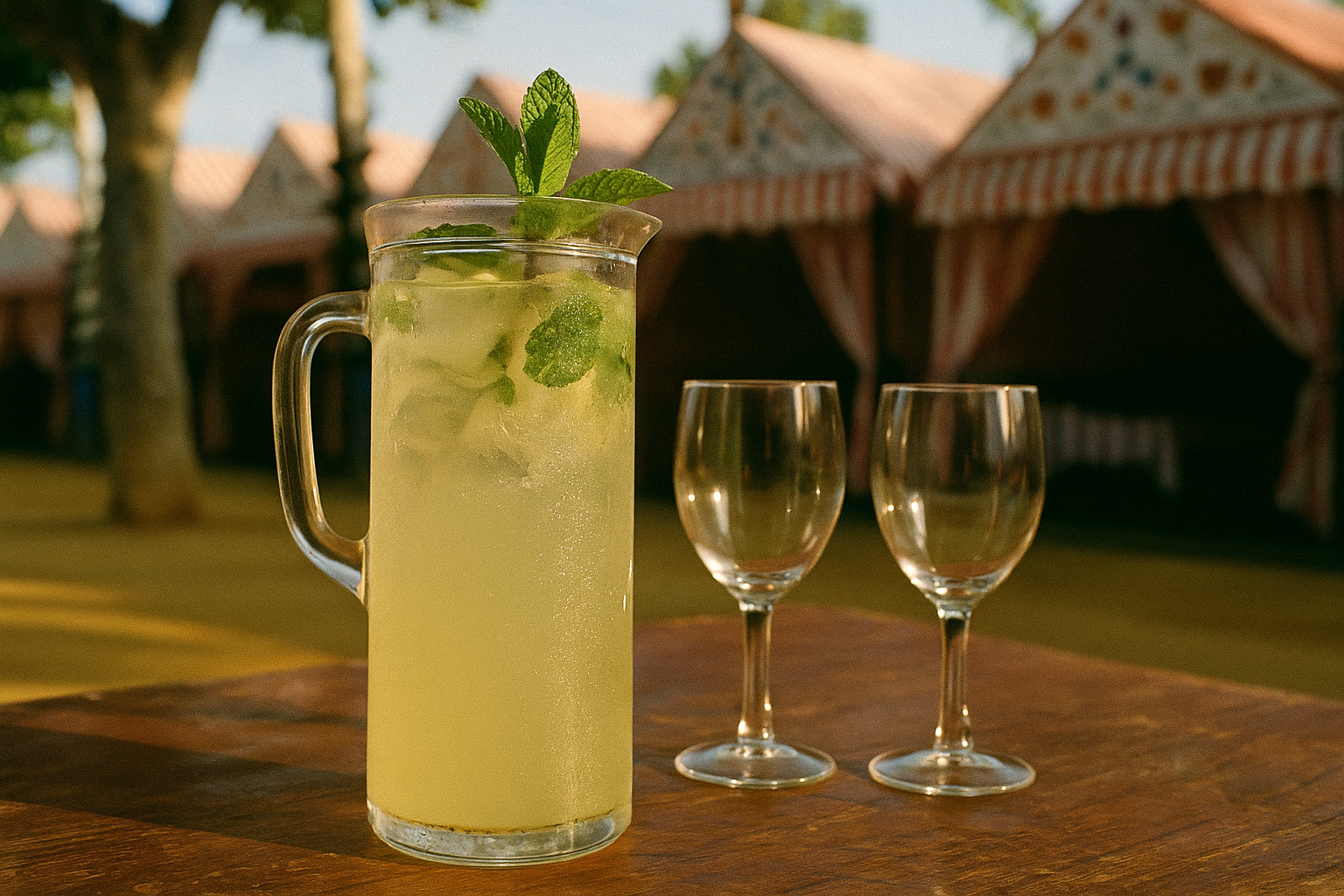
Rebujito is manzanilla sherry or fino sherry mixed with lemon-lime soda. That is the entire recipe. The ratio is one part sherry to three parts soda, served over ice in a tall glass, traditionally with a sprig of fresh mint or a slice of lemon.
Manzanilla and fino are the two dry sherries produced in the Sherry Triangle — the area around Jerez de la Frontera, Sanlúcar de Barrameda, and El Puerto de Santa María. Both are pale, bone-dry, and highly aromatic. Manzanilla, which comes specifically from Sanlúcar de Barrameda on the coast, carries a slight saline note from the sea air that enters the bodegas during ageing. Fino, produced further inland in Jerez, is drier and more austere. At Feria, manzanilla is the traditional choice, but fino works equally well.
The soda is Sprite or 7-Up in most commercial settings, though any clear lemon-lime carbonated drink serves the same function. The soda extends the sherry, chills the drink, softens the alcohol, and adds effervescence. Rebujito at its best is refreshing, lightly floral, and cold enough to make Seville’s April heat manageable.
Where rebujito came from
Rebujito became the dominant drink of Feria in the 1980s. Before that, sherry was drunk straight at the fair: small glasses of manzanilla or fino consumed quickly at the bar of a caseta (the striped marquee tents that house Feria’s social life). The problem with straight sherry at a ten-day fair that starts at noon and runs until dawn is obvious.
Mixing sherry with soda solved the problem. The diluted drink contains roughly the same alcohol as a glass of wine (around 10 to 11 percent once mixed), can be consumed at a pace that does not require counting glasses, and stays cold in the Seville heat in a way that a small copita of room-temperature sherry does not.
The name comes from the Andalucian verb rebujarse, which roughly means to wrap yourself up, to bundle together. The drink bundles together two things that work better combined than separate. The name stuck, the drink spread, and by the 1990s rebujito had become inseparable from Feria culture.
How rebujito is served at Feria
At Feria, rebujito is not served by the glass. It is served by the jarra — a tall glass pitcher holding roughly a litre, prepared in the caseta bar and brought to tables or downed by groups at the bar. The jarra contains ice, the sherry, the soda, and mint or lemon depending on the caseta’s preference. A jarra costs between €14 and €16 at most Feria casetas, though public casetas (those run by the city and open to anyone) are cheaper than private ones.
The culture around rebujito at Feria is collective. You order a jarra for the group. You top up each other’s glasses. You do not nurse a single glass the way you might with a cocktail in a bar. The drink is social infrastructure as much as it is refreshment.
Casetas are of two types: private, run by families, penas (social clubs), or businesses, and public, run by the city and open to anyone without invitation. The most famous private casetas can seat hundreds of people and are impossible to enter without knowing someone with membership. Public casetas require no invitation and serve the same rebujito.
How to make rebujito at home
The recipe scales to whatever volume you need. The ratio is always one part sherry to three parts soda.
For one glass:
50ml manzanilla or fino sherry
150ml Sprite or 7-Up
A generous handful of ice
A sprig of fresh mint or a slice of lemon
Put the ice in a tall glass first. Pour the sherry over the ice, then the soda. Do not stir aggressively — a gentle stir preserves the carbonation. Add the mint or lemon. Drink immediately while cold.
For a jarra (serves four):
200ml manzanilla or fino
600ml Sprite or 7-Up
Ice to fill the pitcher
Several sprigs of mint
The sherry must be refrigerated before mixing. Warm sherry mixed with soda produces a flat, sweet drink that bears no resemblance to a good rebujito. Buy the smallest bottle of manzanilla that will fit in your fridge and keep it cold from the moment you open it.
Which sherry to use
For rebujito, use manzanilla or fino. Do not use amontillado, oloroso, cream sherry, or Pedro Ximénez. These are sweeter and darker styles with flavour profiles built for sipping slowly or pairing with food, not for mixing with soda.
Good manzanillas for rebujito that are available in most Spanish supermarkets and specialist shops abroad: La Gitana (Hidalgo), Solear (Barbadillo), and Pastora (Barbadillo). Fino alternatives: Tío Pepe (González Byass) and La Ina (Lustau). In Spain, a bottle of reasonable manzanilla or fino costs €4 to €8. The brand matters less than the style — any dry manzanilla or fino works.
Avoid bottles that have been sitting open on a shelf for weeks. Manzanilla and fino are the most perishable of the sherries and begin to oxidise and flatten within days of opening, even when refrigerated. Buy fresh, keep cold, use quickly.
Rebujito beyond Feria
Rebujito is associated so specifically with Feria that it feels odd to drink it in other contexts, but it appears at other Andalucian fiestas (the Romería del Rocío, local ferias throughout the region) and works perfectly well as a warm-weather aperitivo anywhere.
In Seville, you will occasionally see rebujito on bar menus, especially in spring and summer. In the UK and internationally, it has begun appearing on cocktail menus as bartenders have discovered the combination. It pairs well with fried food — boquerones, patatas bravas, pringá montaditos — because the acidity and carbonation cut through oil effectively.
What it does not translate is the experience. Rebujito at Feria, served in a caseta decorated with paper lanterns, with sevillanas playing from the stage and people in trajes de gitana around you, is not the same thing as the same two ingredients in a glass at home. The drink is partly a cultural artifact. But the flavour is worth recreating anyway.
Frequently asked questions
What is the alcohol content of rebujito?
At the standard 1:3 ratio with a 15 percent ABV manzanilla mixed with soda, rebujito comes out at roughly 3.75 percent ABV — similar to a light beer. This is part of the reason it is the drink of a ten-day fair. It is low enough to drink continuously without the immediate consequences of straight sherry, high enough to sustain the festive atmosphere.
Can you make rebujito with white wine instead of sherry?
You can, but it will not be rebujito. The dry, saline, almond-tinged character of manzanilla or the austere nuttiness of fino are specific to the biologically aged sherry style. White wine mixed with soda produces a different drink — perfectly acceptable, but lacking the distinctive flavour that makes rebujito work.
Is rebujito drunk outside of Seville?
Rebujito appears at ferias throughout Andalucia and at the Romería del Rocío in Huelva, one of Spain’s largest pilgrimages. Outside the feria context, it exists on some bar menus across Spain in warm weather but is not widespread. It is fundamentally a feria drink and most Sevillanos would find it strange to drink one in January.
What food pairs well with rebujito?
The acidity and effervescence make rebujito an effective match for fried and fatty foods: pescaíto frito (fried small fish), croquetas, pringá, jamón. It also works with the simpler Feria food — the boquerones en vinagre and papas aliñás (potato salad with vinegar and oil) that most Feria casetas serve alongside the drinks.
When is Feria de Abril?
Feria de Abril takes place in Seville two weeks after Easter Sunday, typically in late April. The fair runs for six days officially, though the real duration including the opening alumbrado (illumination ceremony) and the closing fireworks is eight days. The dates shift each year with the Easter calendar — check the Seville city council website for exact dates for the year you are travelling.
A final note on drinking rebujito correctly
Rebujito is not a drink to analyse. At Feria, it is consumed in quantity, in heat, while dancing sevillanas and talking loudly over music. The point is the combination of refreshment, moderate alcohol, and cold drink against hot air. If you are making it at home, make a jarra for several people, put it in the fridge for 20 minutes before serving, and drink it quickly. Rebujito that warms up is still drinkable. Rebujito that is icy cold is the point.
Planning to attend Feria? See our full guide to what to eat at Feria de Abril. Staying in Santa Cruz before or after? Read our guide to eating in Santa Cruz without getting ripped off.
Found a correction or an update?
Email us at hello@spainfoodguide.com — we keep our entries current.
Run a restaurant in Spain you think we should know?
Get featured →