A Day with a Third-Generation Valencian Paella Cook
The fire goes in first. Before the chicken, before the rabbit, before anyone speaks, a Valencian paella cook lays orange-tree branches in a bed of pale ash and waits for them to catch. This is not theatre. This is the architecture of a dish that predates the pan itself. In El Palmar, the fishing village inside the Albufera lagoon ten kilometres south of Valencia city, families have been repeating this sequence every Sunday for a hundred and fifty years. The pan arrives last. The fire decides everything.
What follows is a composite day drawn from published interviews with Rafa Margós of Casa Carmela, María José Estevens of Arrocería Maribel, Quique Dacosta and Ricard Camarena, stitched together with research from Wikipaella and the D.O. Arroz de Valencia. No direct dialogue is invented. Every quoted line belongs to a printed source.
Quick Answer: What Makes a Paella Valenciana
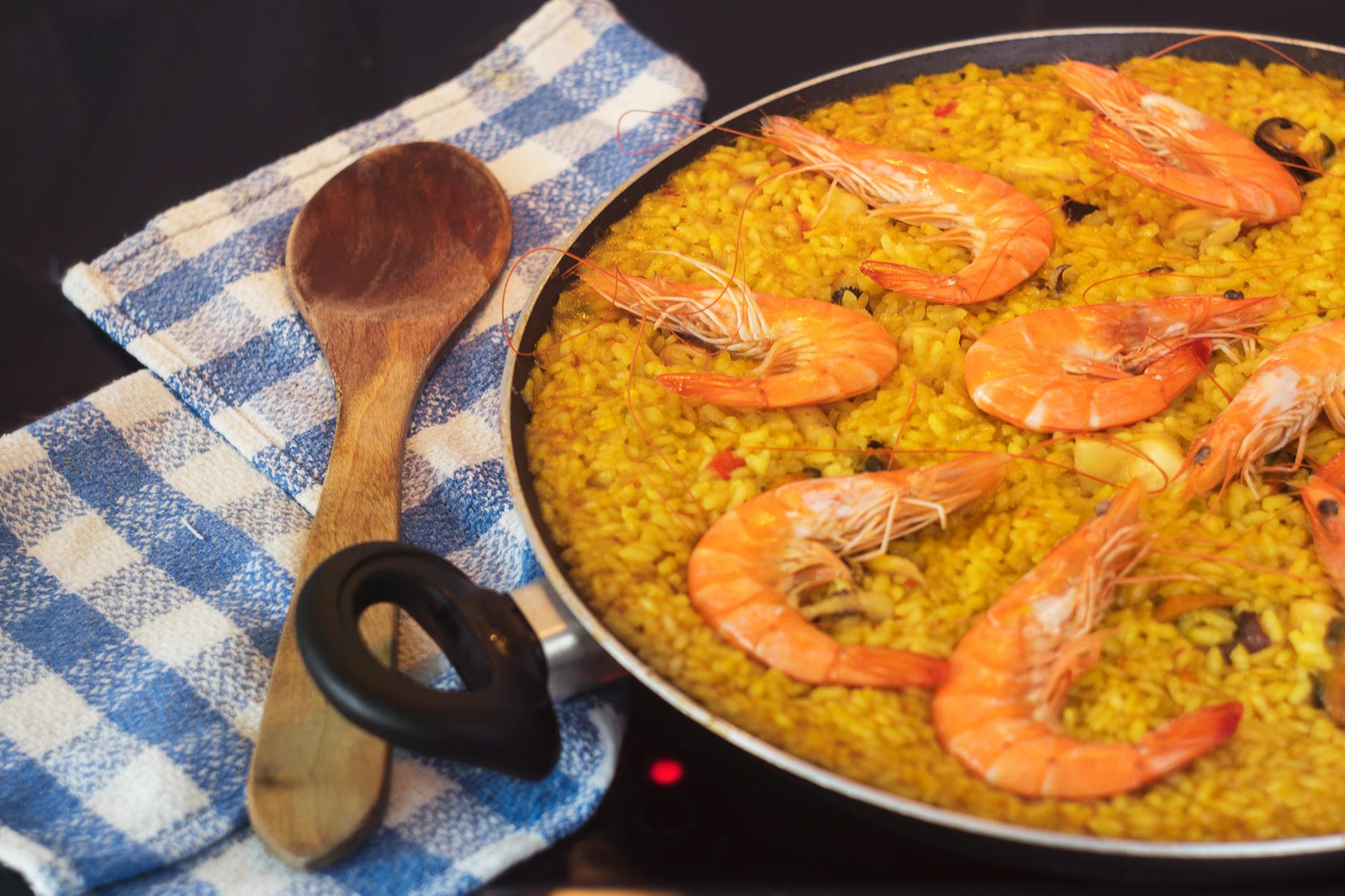
Authentic paella valenciana contains ten ingredients: chicken, rabbit, garrofó (a flat white bean), ferradura (flat green bean, also called tavella in smaller form), ripe tomato, rice of a D.O. Arroz de Valencia variety (most commonly bomba or senia), sweet pimentón, saffron, rosemary, and water. The cook builds it in a shallow steel pan over an open orange-wood fire, finishes it dry enough to caramelise a crust of rice on the pan floor called the socarrat, and serves it straight from the pan with wooden spoons. That is the canon. Everything else is another dish.
Dawn on the Albufera
At 06:15 the Albufera is still steel-grey. The lagoon sits inside a natural park of 21,000 hectares of rice paddies, reed beds and fishing tracks, and at this hour the only movement is a heron lifting from the water. A paella cook from one of the old El Palmar families walks the bund between two paddies. One hand holds dried orange-tree prunings, the other a net of garrofó pods collected yesterday.
The paddies belong, legally, to the D.O. Arroz de Valencia. The designation protects the rice, not the finished paella. This distinction matters because it is the source of a common misunderstanding. No designation of origin exists for the dish itself. Only the grain, grown in wetlands across Valencia, Castellón and parts of Alicante, is protected. Approved varieties include bomba, senia, albufera, j. sendra, bahia, montsianell, gleva and sarçet, with bomba and senia accounting for most paella rice sold in the region.
The sky goes from steel to apricot in under twenty minutes. By the time the cook reaches the kitchen door, the lagoon has turned gold.
The Ten Ingredients, Gathered
Inside, the morning’s work is already laid out on a long wooden table. The count is deliberate.
The 2012 regional effort to enshrine a Protected Designation of Origin for the dish itself never crossed the finish line, but it produced something more durable: a map of agreement. When the Valencian nonprofit Wikipaella spent a year and a half driving over 700 kilometres across the region, interviewing more than 40 cooks and visiting more than 200 restaurants, they landed on ten ingredients that nearly every household and traditional kitchen agreed on. A later peer-reviewed survey published in the International Journal of Gastronomy and Food Science backed the finding, documenting that nine of the ten appeared in more than 90% of home kitchens surveyed. Rabbit was the tenth, at 88.9%. Sweet paprika, the eleventh most common, appeared in 62.5% of kitchens, which is exactly why it sits on the border between canon and option.
On the table today:
- Chicken and rabbit, cut on the bone and salted early.
- Garrofó, the broad flat lima-type bean that Valencians consider non-negotiable.
- Ferradura (flat green bean) and its smaller cousin tavella, a white bean used in certain villages and seasons.
- Ripe tomato, grated, waiting for the sofrito.
- Pimentón dulce, the sweet paprika that goes in last before the water.
- Saffron, a few threads, crumbled between fingers.
- Rosemary, a single sprig, picked this morning.
- Arroz de Valencia, today a senia (the variety most local cooks favour for its softer finish) from a co-operative down the road.
- Olive oil and salt, because a cook counts those separately.
- Water. Local water. Specifically local water. Older cooks in El Palmar will tell you the calcium balance of the well water is part of the flavour, and they are not joking.
The Wikipaella list and the academic paper agree. Chorizo does not appear on either. Neither does onion, which Valencian purists claim turns the rice pasty, nor peas, nor a single grain of basmati.
The Fire is the Ingredient
Rafa Margós, fourth-generation paella cook at Casa Carmela (founded in Valencia in 1922 and run by the descendants of Doña Carmen), has spent two decades codifying what Valencian cooks know by touch. In an interview published by El Paeller, the firewood house he co-founded, Margós returns to one point: the fire is not a heat source. It is an ingredient.
He uses orange wood exclusively. Naranjo. The wood burns hot and clean, throws a flame that licks the base of the pan in rings rather than columns, and carries a faint citrus note in the smoke. Pine burns too resinous. Olive burns too slow. Oak throws too much ember. Orange, cut from old groves and dried for at least a year, sits in the narrow band where the flame is aggressive enough to heat a 70cm pan evenly but clean enough not to taint the rice.
The flame peaks in the first five minutes when the meat hits the oil. It calms during the sofrito. It rises again when the broth and rice go in. And it drops, deliberately, to a low ring for the final seven or eight minutes, when the water has gone and the cook is listening for the socarrat.
Paella or Arroz? The Debate that Never Quite Ends
Somewhere around midmorning, a conversation begins that has been running in Valencian kitchens for thirty years. It surfaces in the food press, resurfaces at family tables, and has never been fully resolved.
On one side: a dish is called paella only when it follows the canonical ingredients. Anything else is arroz. A rice dish with fish is arroz a banda or arroz del senyoret. One with vegetables only is arroz de verduras. A seafood variant is paella de marisco (a name Valencian purists quietly wince at). The word paella, in this reading, belongs to one recipe.
On the other side sits the contemporary chef’s argument. Quique Dacosta, three Michelin stars in Dénia and another at El Poblet in Valencia, has written a book, Arroces Contemporáneos, on the subject, and opened a rice restaurant in London called Arros QD. He treats rice as a category, not a recipe. In published remarks he insists that authentic paella valenciana has its rules and you do not deviate from them, but rice deserves the full freedom of technique. He has called Valencian rice “as valuable as truffles and saffron”.
Ricard Camarena, two Michelin stars and three Repsol Soles at his Valencia restaurant, frames it differently in an Infobae feature. He has “too much respect for the tradition”, he says, and does not try to compete with a traditional cook on a traditional dish. Instead he deliberately makes “rice dishes for non-Valencians”.
Both chefs agree, in effect, on the same line. Paella has rules. Rice has freedom. Mix the two and a Valencian will correct you.
The Build
By 12:30 the fire is steady and the pan is down. The cook works in a choreography that has been timed, over generations, to the minute.
- Minutes 0–8: Olive oil in. Salt. Chicken and rabbit go skin-side down and brown slowly.
- Minutes 8–15: The meat moves to the edges. Ferradura and garrofó go into the clearing at the centre. Grated tomato follows, cooking down until almost dry.
- Minute 15: Pimentón goes in and the cook counts to three. Longer and it burns, and burnt paprika turns the paella bitter beyond rescue.
- Minutes 15–20: Boiling water from the kettle, up to the rivets on the pan handles. Saffron crumbled in. The rosemary sprig laid across the surface. The broth simmers hard for ten minutes and tastes of everything.
- Minute 25: Rice goes in, sprinkled in a cross and then smoothed flat. The rosemary is removed. From this moment the cook does not stir. A Valencian will stop you physically if you reach for a spoon.
- Minutes 25–35: The broth reduces. The surface flattens and glosses.
- Minutes 35–42: The liquid disappears into the grain. The cook listens. When the quiet bubbling gives way to a faint crackle, the socarrat is forming. The fire comes up one final time for twenty or thirty seconds, then dies.
- Rest: Five minutes, covered with a cloth or newspaper. Never a lid.
The socarrat, the toasted layer of rice stuck to the pan floor, is the reward. It is never a mistake. A paella without socarrat is an unfinished paella.
The Sunday Table
Sunday is when the full ritual plays out. In El Palmar, in the villages ringing the Albufera, and increasingly in Valencia city flats with a gas ring on the terrace, paella belongs to Sunday afternoon the way a roast belongs to an English Sunday. Families eat directly from the pan. Wooden spoons only, because metal ones scrape the socarrat and heat the rice unevenly on the way to the mouth. Each person works an invisible wedge, straight out from their seat towards the centre. You do not cross into a neighbour’s slice. That is considered both rude and unlucky.
Restaurants around the Albufera build their week around this rhythm. Arrocería Maribel, awarded Bib Gourmand in the Michelin Guide España 2026 and run by chef María José Estevens, serves a daily list of rice dishes anchored by paella valenciana, all cooked to D.O. Arroz de Valencia standard. Casa Carmela in the city, four generations in on the same recipe, still cooks every paella over orange wood to order, with a wait that can stretch to ninety minutes because the fire does not negotiate.
The meal stretches. Bread. Salad of tomato and spring onion. A digestif. Coffee. The pan goes cold on the table and someone, eventually, scrapes the last socarrat with the edge of a spoon and hands the piece around.
Paellas con Cosas Raras
The phrase paellas con cosas raras, “paellas with weird things”, is not a joke. It is a line drawn in the sand. In December 2025, Valencian paella expert Ana García told Que.es that “the paella you make with chorizo is an error from the 80s”, pointing out that the Wikipaella canon and the ingredient research produced since explicitly exclude the sausage. Valencians, she said, have been correcting it for forty years.
The objection is not arbitrary. Chorizo releases enough rendered fat and aggressive paprika to swamp the sofrito, which is built on the more delicate balance of tomato, olive oil and sweet pimentón. Onion does the same in a different direction, softening the grain and muddying the broth. Peas add nothing. Chef Jamie Oliver’s chorizo-and-chroizo recipe set off a minor international incident in 2016 when Valencians pointed out, loudly and across several languages, that the dish he was showing the world was not paella. It had a name already. Arroz con cosas. Rice with things.
The outrage looks precious from the outside. From the inside, it is cultural self-defence. When an entire region shares one dish across a century of Sundays, the dish becomes shorthand for the place. To get it wrong is not a small thing.
The Quiet Part
What the published record does not quite capture, but the cooks themselves hint at in interview after interview, is the weight of generational transfer. Rafa Margós learned from his mother, who learned from hers, who learned from Doña Carmen, who opened Casa Carmela in 1922. María José Estevens learned from the cooks who built El Palmar’s reputation as the birthplace of the dish. The paella is less a recipe than a lineage. The measurements live in hands, not notebooks.
Ask any El Palmar cook how much water goes into the pan and the answer is the same: to the rivets. Ask how much rice, and the answer is a handful per person, measured by eye. Ask how you know the fire is right, and the answer is that you know. The ten ingredients are stable. Everything around them is tacit knowledge, passed down through standing beside someone at the pan for a thousand Sundays.
FAQ
What are the ten official ingredients of paella valenciana?
Chicken, rabbit, garrofó (flat white bean), ferradura (flat green bean), ripe tomato, rice of a D.O. Arroz de Valencia variety, sweet pimentón, saffron, rosemary and water. Olive oil and salt are counted separately in some lists. Wikipaella codified this list after field research across the region.
Why do Valencian cooks insist on orange wood?
Orange wood, or naranjo, burns hot and clean, throws an even ring of flame around the base of the pan and carries a faint citrus aroma in its smoke. Cooks like Rafa Margós of Casa Carmela treat the fire itself as an ingredient. Pine is too resinous, oak too ashy, olive too slow.
Is there a Denomination of Origin for paella?
No. The D.O. covers Arroz de Valencia, the rice, not the finished dish. Approved rice varieties include bomba, senia, albufera and others grown in wetlands across Valencia, Castellón and parts of Alicante.
Why is chorizo in paella a controversy?
Chorizo is not among the ten canonical ingredients. Valencian cooks and food writers (most recently Ana García in a December 2025 Que.es piece) argue that chorizo’s rendered fat and strong paprika destroy the delicate balance of the sofrito. A rice dish with added ingredients outside the canon is called arroz con cosas in Valencia, not paella.
What is the socarrat?
The socarrat is the caramelised, toasted layer of rice stuck to the bottom of the pan at the end of cooking. Forming it is the goal of the final two minutes over fire. A paella without socarrat is considered underfinished by Valencian cooks.
Where is the birthplace of paella?
El Palmar, a fishing village inside the Albufera Natural Park ten kilometres south of Valencia city, is widely considered the home of paella valenciana. The Albufera’s rice paddies supply most of the grain used in the dish.
Should you stir paella after adding the rice?
No. Once the rice goes in, Valencian cooks do not stir. Stirring activates the starch and disrupts the formation of the socarrat. The rice cooks undisturbed until the liquid is absorbed.
When do Valencians eat paella?
Sunday lunch is the traditional moment, usually eaten outdoors in spring and summer, with the family gathering around a single pan and eating directly from it with wooden spoons.
Finish the Day in Valencia
If you want to watch this unfold in real time, take a train from Valencia Nord to the edge of the Albufera Natural Park, or a bus straight into El Palmar. Book an early lunch at Arrocería Maribel (Bib Gourmand 2026) or a long Saturday lunch at Casa Carmela in the Cabanyal quarter of Valencia city. Ask for paella valenciana by name. Watch the pan come out. Do not reach for a spoon until the cook says so.
For the grain itself, look for the D.O. Arroz de Valencia seal on bomba or senia rice. For the rest, trust the fire.