
Salmorejo and gazpacho are both cold tomato soups from Andalucia. They are not the same dish. They are not interchangeable. They come from different cities, use different ingredients, and serve different purposes at the table. Understanding the differences makes you a more competent eater in southern Spain and helps you choose the right one for what you actually want.
The fundamental difference: bread
The single ingredient that separates salmorejo from gazpacho is bread. Salmorejo contains a substantial quantity of stale white bread, blended into the soup until it thickens to the consistency of a light purée. Gazpacho contains no bread in its traditional form, though some regional variations add a small amount.
This difference determines everything else: the texture, the colour, the calorie count, the garnish, and the way each dish functions at the table.
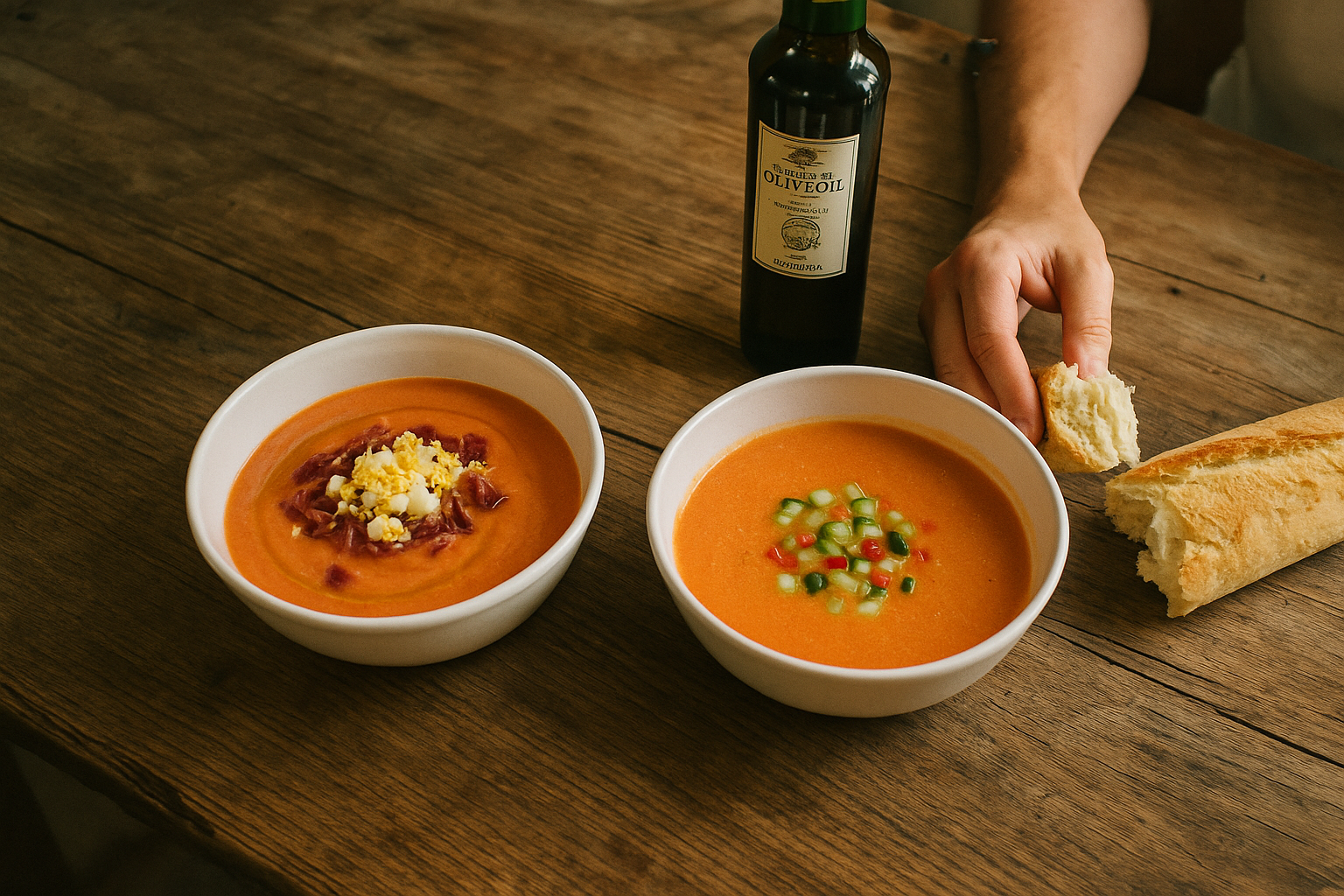
Salmorejo is thick. It coats a spoon, holds its shape briefly when poured, and is served in a bowl or wide glass and eaten with a spoon. The colour is a deep, saturated coral-red because the bread absorbs the tomato without diluting it.
Gazpacho is thin. It pours like a juice, can be drunk from a glass, and is sometimes served in a cup rather than a bowl. The colour is lighter — a diluted orange-red — because the liquid is not concentrated by bread.
Where each comes from
Salmorejo is from Córdoba, a city in the interior of Andalucia about 140 kilometres northeast of Seville. It is a Córdoba dish. If someone in Córdoba says “pásame el salmorejo” they mean the specific Córdoba preparation: tomatoes, bread, olive oil, garlic, and salt, blended until smooth, served cold with jamón and hard-boiled egg on top.
Gazpacho is pan-Andalucian with claims from multiple provinces. The most common version associated with Seville and the broader Guadalquivir valley includes tomato, cucumber, green pepper, onion, garlic, olive oil, vinegar, and salt. Different provinces emphasise different vegetables and different balances of acid and sweetness.
Both dishes share the defining characteristic of Andalucian cooking: they were created as peasant food to use what was abundant. Bread, tomatoes, olive oil, and garlic were always available. Cold liquid food was practical in summer heat. What we now eat in restaurants as elegant cold starters began as field workers’ meals.
The recipe comparison
Salmorejo (Córdoba style):
1kg ripe tomatoes
200g stale white bread (crustless, soaked briefly in water)
1 garlic clove
100ml extra virgin olive oil (Córdoba favours Picual variety)
Salt to taste
Blend everything together until completely smooth. The bread gives the soup its body and the texture should be thick enough that a drizzle of olive oil sits on the surface without immediately sinking. Serve cold, topped with jamón ibérico cut into small pieces and quartered hard-boiled egg. Drizzle additional olive oil over the top.
Gazpacho (Sevillian style):
1kg ripe tomatoes
1 green pepper
1 cucumber, peeled
1 small onion or 2 spring onions
1 garlic clove
100ml extra virgin olive oil
3 tablespoons sherry vinegar
Salt to taste
Water to adjust consistency
Blend everything, pass through a sieve for a smoother result, adjust with water to the desired thickness. Serve cold with small bowls of garnish (diced cucumber, diced pepper, croutons) for people to add themselves.
The garnish
This is where the visual difference is most striking. Salmorejo arrives at the table with jamón and egg on top: the coral soup against the deep red-brown of cured ham and the white and yellow of egg. It is one of the more visually complete small plates in Spanish cooking.
Gazpacho traditionally arrives with separate garnish bowls so each person can add their own diced vegetables and bread. This is the older tradition. In restaurants, gazpacho is often served with no garnish at all or with a small float of olive oil on top.
The jamón on salmorejo is not decorative — it provides saltiness and the concentrated umami of cured meat against the sweet acidity of the tomato-bread base. Removing it produces a different dish.
Calories and richness
Salmorejo is significantly more calorie-dense than gazpacho. A 200ml serving of salmorejo typically contains 300 to 400 calories, driven by the bread and the generous olive oil. A similar serving of gazpacho runs 150 to 200 calories. Salmorejo functions as a light meal or a substantial starter. Gazpacho functions as a refresher or a light starter.
At a restaurant in Córdoba, salmorejo is often eaten as a first course before a heavier main. In summer heat, the cool acidity of gazpacho serves better as something to drink between courses or before eating. The two dishes occupy different positions in a meal despite superficially resembling each other.
Where to eat each
For salmorejo: Córdoba is the obvious answer, but good salmorejo exists throughout Andalucia. In Seville, order it at any traditional tapas bar. The quality indicator is the colour: it should be deeply saturated coral, not pale pink (too much bread) or watery red (not enough bread). The garnish should be generous enough that you get jamón and egg in most bites.
For gazpacho: The best gazpacho in Spain comes from late August to early October, when tomatoes reach peak ripeness. Outside this window, gazpacho made from inferior tomatoes is thin, acidic, and uninteresting. Any decent restaurant in Seville, Málaga, or Almería in summer serves good gazpacho. In winter, salmorejo is the better choice because it does not depend on tomato quality in the same way.
Variations worth knowing
Porra antequerana: From Antequera in Málaga province. Thicker than gazpacho, similar to salmorejo in consistency, but with a slightly different flavour profile from the specific tomato and pepper ratios used in the area. Served with the same jamón and egg garnish as salmorejo.
Ajo blanco: Often described as white gazpacho, this is a completely different dish — ground almonds, stale bread, garlic, olive oil, and vinegar, served cold. There is no tomato. It is native to Málaga and the Granada area and predates tomato-based cold soups in Spain by several centuries (almonds have been grown in Spain since the Moorish period; tomatoes arrived from the Americas in the 1500s).
Gazpacho manchego: Nothing to do with Andalucia. A warm meat stew from Castilla-La Mancha made with flatbread. The shared name is coincidental and a source of ongoing confusion.
Frequently asked questions
Which is healthier, salmorejo or gazpacho?
Both are nutritionally dense with vitamins from tomatoes and healthy fats from olive oil. Gazpacho is lower in calories and carbohydrates because it contains no bread. Salmorejo provides more sustained energy from the bread and oil but is more calorie-dense. Neither is unhealthy — they are made from vegetables, olive oil, and in salmorejo’s case, good bread.
Can you make salmorejo without bread?
You can blend tomatoes, oil, and garlic without bread and get a smooth tomato soup, but it will not be salmorejo. The bread is the defining ingredient that gives salmorejo its characteristic thickness, colour intensity, and body. A breadless version is closer to a smooth gazpacho than to a salmorejo.
What type of bread is used in salmorejo?
Stale white bread, crustless, without seeds or additions. Telera, the traditional bread of Córdoba, is used in the city. Outside Córdoba, any good white country bread works. The bread should be at least a day old. Fresh bread produces a gluey texture; stale bread blends more smoothly into the soup.
Is gazpacho always served cold?
Yes. Hot gazpacho is not a thing in Andalucia. The cold temperature is not optional — it is structural to the dish. Gazpacho emerged as a summer food specifically because it required no cooking and could be kept cool. Serving it warm would produce a completely different experience and is not traditional anywhere in Spain.
What is the best olive oil for salmorejo?
Use extra virgin olive oil from Andalucia if you can find it. The Picual variety grown in Jaén province (which produces more olive oil than any other region in the world) has a robust, peppery, slightly bitter flavour profile that works exceptionally well in salmorejo. Córdoba’s own Picudo and Hojiblanca varieties are also used locally. In salmorejo, you taste the olive oil directly, so quality matters more than it does in a cooked dish.
The bottom line
Order salmorejo when you want something substantial, satisfying, and unmistakably Andalucian — the deep coral soup with jamón and egg on top is one of the best starters in southern Spanish cooking. Order gazpacho when you want something light, refreshing, and cool — it is best in high summer when the tomatoes are at their peak and the temperature outside makes cold liquid food genuinely welcome.
Both deserve to be eaten in context. In Córdoba, order salmorejo and compare it against every other version you will encounter on the trip. In a Seville bar on a July afternoon, order gazpacho and drink it like the cold liquid food it is. They are excellent dishes. They are just not the same dish.
Visiting Córdoba? See our guide to eating in Seville before you head north. Want to cook like a local? Read our guide to making paella the Valencian way.
Found a correction or an update?
Email us at hello@spainfoodguide.com — we keep our entries current.
Run a restaurant in Spain you think we should know?
Get featured →