
A Night at a Basque Cider House: Txotx Season Explained
The road out of Donostia climbs for twenty minutes, past fog on the Urumea river, past the last petrol station, into a valley of dark oak and bare apple trees. The sign says Astigarraga. Population just under 8,000. Cider houses: nineteen.
This is the Sagardoaren Lurraldea, the Basque Ciderland, a triangle of three small towns (Astigarraga, Hernani, Usurbil) that produces almost every bottle of natural Basque cider you will ever drink. From mid-January to late April, this is where the whole region comes to eat. Not the restaurants of San Sebastián. Here.
The ritual has a name: txotx. It is the call shouted across a cold room. It is the wooden peg in the side of a giant barrel. Tonight, for around 40 euros, you are about to take part in it.
Quick Answer: What is Txotx Season?
Txotx is the Basque cider-house ritual. Between roughly 19 January and late April, producers open their enormous wooden barrels (kupela) to let diners taste the new season’s natural cider straight from the cellar. When the cider maker shouts “Txotx!” you stand up, walk to the barrel, hold your glass low and at an angle, and catch a few fingers of cider as it jets from a small open tap. You sit back down. You eat a set menu of chorizo, cod omelette, grilled ox steak, cheese and walnuts. You repeat. That is the night.
The Drive into Cider Country
You leave Donostia after dark because the locals do. Sagardotegi lunches exist, but the proper experience is dinner, in winter, in the cold. You want the room to feel like a refuge.
Astigarraga sits eight kilometres inland from the sea, on the slope below Mount Santiagomendi. Hernani is the next valley over. Usurbil is west. Between them, according to the Sagardoaren Lurraldea tourism board, the three towns hold more than 100 cider houses. Nineteen of them are inside Astigarraga alone.
You pull into a gravel car park. The building is a caserío, a Basque stone farmhouse, whitewashed walls and red window frames, part of it easily 300 years old. Cooking smoke drifts from a tile chimney. Nobody greets you with menus. There is no maître d’. You walk in and follow the sound.
Inside is a barn. Stone floors. Exposed beams. Forty metres long. The ceiling disappears into dim industrial lights. The air smells of wood, apples, smoked chorizo and grilled meat, in that order, and it hits you in one note before your eyes have adjusted.
The Long Wooden Tables
There is no seating plan. No tablecloths. Long rough planks on trestles, bench seating, and an understanding that your party of four will share elbows with a party of eight from Bilbao and a retired couple from Irun.
Places are already set: a small wedge of Idiazabal, a block of quince paste (membrillo) and a pile of walnuts still in their shells, with a nutcracker between each pair of seats. You will eat those later. For now they sit there as signals. The landlord has decided the room is ready.
A waiter brings bread, empty pint-sized glasses, and a first, uninvited plate. The glasses are heavy, wide-mouthed, shallow. That shape matters. The person you sit next to might be a chef from Biarritz, an apple farmer from Urnieta, a birthday party from Pamplona. The rules are the same for everyone.
The room is loud. The room is supposed to be loud. In the old days, the gastronomic societies of San Sebastián would drive out here, buy cider in bulk, and cook their own food on the cellar hearth while they tasted the barrels. Many of the dining customs tonight (communal tables, the fixed menu, the informality) come from that earlier period.
The Call of Txotx
Twenty minutes in, the cider maker walks into the middle of the room, raises a bucket, and shouts one word.
“Txotx!“
Chairs scrape. Conversation pauses. Half the room stands up with their empty glasses and starts to move, in no particular order, toward the doorway at the back. You follow.
You pass through into the cellar and the temperature drops by five degrees. This is the kupela hall. It is the real reason you are here.
At Zapiain, according to the family’s own account on their official site, the cellar holds 22 chestnut-wood kupelas, each one 15,000 litres. Nicolás Roxario Zapiain built them between 1961 and 1964. They stand two storeys tall. They are the size of small houses and they are older than most of the people in the room.
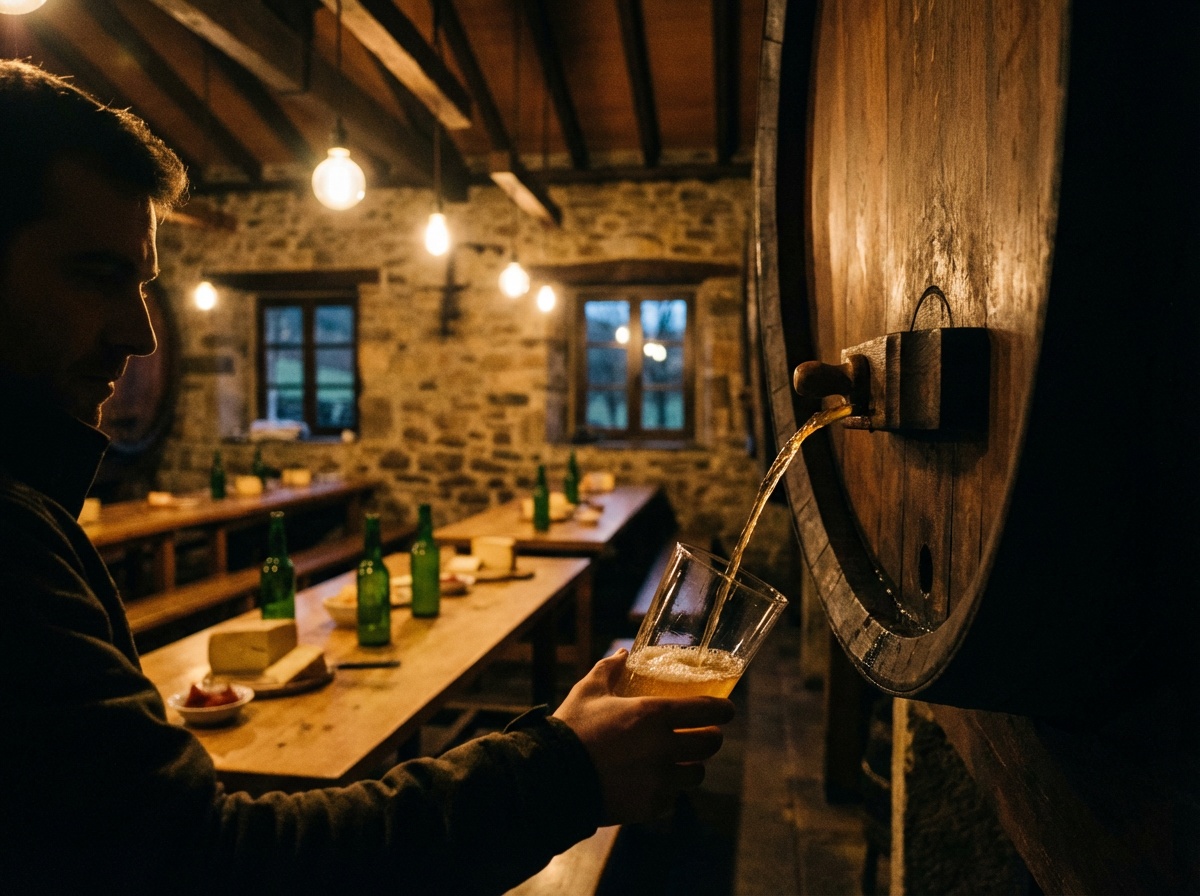
The cider maker walks to the front of one barrel. He pulls out a wooden peg no bigger than a marker pen. That peg is the txotx. It has given the ritual its name. Through the small hole behind it, at roughly head height, a thin jet of amber cider hisses out into the air at a surprising pressure and arcs across the cellar floor.
The dates around this moment are precise. The official Basque Country cider season opens on or around 19 January (timed to coincide with Donostia’s Tamborrada festivity) and runs until the end of April or early May, when the barrels have been drained and the next year’s fermentation begins. According to Sagardoa.eus, the region’s official cider tourism body, the tradition now draws close to one million visitors per season.
Catching Cider at an Angle
You queue. You do not pour. This is the detail visitors get wrong.
When your turn comes, you step up to the barrel with the glass held low, almost at knee height, tipped so the rim faces the jet at a sharp angle. You let the stream of cider hit the inside lip of the glass, not the bottom. It breaks against the glass. It aerates. The cider foams briefly, releases its wild apple scent, and settles.
You take three fingers. No more. Then you step back and the next person takes over. You do not linger. The person behind you is waiting.
Why the angle? Natural Basque cider (sagardoa) is unfiltered, unpasteurised, very lightly sparkling, and comparatively low in alcohol (usually around 5% to 6%). It is flat in the bottle and dull on the palate if poured conventionally. Smashing it against the glass forces oxygen into the liquid and activates aromatics that would otherwise sit quietly below the surface. It is the same principle as decanting, compressed into half a second.
You walk back to your seat. You do not sip slowly. You drink the three fingers in a single long pull while the cider is still alive. Then you wait. Somewhere in the next ten or twenty minutes, the cider maker will shout txotx again, from a different barrel, with a different apple blend. You will stand up again. The night runs like this for four hours.
The Set Menu
You do not order. The food simply arrives, course by course, in the same order it has arrived for the last fifty years. This is the traditional sagardotegi menu, and most houses in the Astigarraga / Hernani / Usurbil triangle run it almost identically. Expect roughly 35 to 46 euros per person, cider included.
What lands on the table:
- Txorizo a la sidra (chorizo cooked in cider). A small cast-iron dish of dense, deeply spiced pork sausage, poached in the house cider until the fat renders into a glossy, paprika-stained sauce. Eaten with bread, for sopping.
- Bacalao tortilla (tortilla de bacalao). A cod omelette. Salt cod, desalinated, flaked into soft eggs and folded at the edges. Unassuming. Extraordinary.
- Bacalao frito con pimientos (fried salt cod with green peppers). Loins of cod in a light batter with blistered Gernika peppers. This second cod course is the step most outsiders don’t expect. There is always more cod than you think.
- Chuletón (txuleta). A thick ox rib-chop grilled over glowing oak and charcoal embers, served rare, sliced off the bone at the table. At Petritegi or Rezola, the steak comes in at around a kilo per two diners. Salt on top. Nothing else.
- Idiazabal, walnuts, membrillo. The dessert that is not a dessert. A wedge of raw-sheep’s-milk Idiazabal cheese (made from Latxa sheep’s milk in the hills that you just drove through), a slab of dark quince paste and the walnuts you have been staring at all night. You crack the shells yourself.
A small plate of pacharán or a glass of sweet Basque patxaran often closes the meal, though it is not officially part of the set.
The Landlord’s Role
The figure who shouts txotx is not a sommelier. He is el nagusi (the landlord or master of the house), and in most cider houses it is the cider maker himself.
At Petritegi, that role has been held by the Otaño-Goikoetxea family since 1890. Petritegi’s own company history records that six generations have run the cellar, with Ainara Otaño (the fifth generation) now leading production. Her father, José Joaquín Otaño, was born in the farmhouse; the site itself has been pressing cider since 1526.
At Zapiain, the family count is similar. More than 500 years, according to the house’s own published history.
The landlord decides almost everything. When the barrels open. When the barrels close. Which kupela gets tapped next (the order runs from lighter blends to deeper, more tannic ones across the evening). Whether the chuletón is ready. When the night ends. He rarely sits down. He tastes every barrel at the start of service and a couple more during. If the cider from one kupela is drinking thin, he skips it.
The landlord is also the one who enforces the quieter rules nobody tells you. Don’t pour your own cider at the table from a bottle if a barrel is running. Don’t over-fill your glass at the txotx. Don’t leave cider in the glass. (In older houses, the small puddle of cider left after each pour is flicked on the floor; that is where the sharp, sweet, cellar-floor smell comes from.) If you break the rules gently, he ignores it. If you break them loudly, you hear about it.
One Thousand Years, Nearly Lost
Cider has been in the Basque hills for a very long time. Farmhouse references to cider production appear in Gipuzkoan documents as far back as the 11th century. By the 1500s, when Petritegi records its founding date, sagardoa was already the everyday table drink of the inland Basque country, drunk in larger volumes than wine.
Then it almost disappeared.
In the early 20th century, imported beer and cheap wine swept into the region. Apple orchards were cut down and replaced with pine plantations to feed the paper industry. Under Franco, cider was quietly discouraged as a marker of Basque cultural identity, a detail confirmed by the cider historians at Ciderzale. For decades, most remaining cider houses served only friends and farmers. The public ritual faded.
The revival started in the late 1970s and accelerated through the 1980s, pushed by a new generation of producers and cultural organisations (Sagardun, the cider-makers’ associations around Astigarraga, and the broader Sagardoaren Lurraldea body). They reopened the doors. They formalised the set menu. They turned what had been a private farmhouse practice into the public txotx season you are standing in tonight. According to Sagardoa.eus, Astigarraga has hosted the official opening ceremony of the season every year since 1994.
The proof is on the hills around you. Since 2017, Euskal Sagardoa (Basque Natural Cider) has had its own Protected Designation of Origin, covering around 115 approved native apple varieties. Azkue’s 1905 Basque dictionary listed more than 80. The orchards are being replanted. The numbers are growing again.
Five Mistakes First-Timers Make
- Booking a weeknight at 10pm. Most sagardotegi kitchens close service by 10.30pm in winter. Book the first seating (around 8pm) so you are still there when the second round of txotx calls go out.
- Pouring from the glass into your mouth normally. The cider is dead within ninety seconds of pouring. Drink it fast and drink it now.
- Over-filling the glass at the barrel. Three fingers only. Anything more loses pressure, and you hold up the queue.
- Saving room for dessert. The chuletón is the end of the meal. The cheese and walnuts are a slow, ritual conclusion. Pace yourself through the cod courses.
- Driving back. Even at 6% alcohol, the pours add up quickly across four hours. Most cider houses run shuttle buses from Donostia, or you can take the Sagardo Bus from the old town. Use it.
Frequently Asked Questions
When is txotx season in the Basque Country?
The season runs from on or around 19 January until late April or early May. The official opening ceremony is held every year at a rotating cider house in Astigarraga, timed to coincide with Donostia’s Tamborrada festivities.
Where are the best Basque cider houses near San Sebastián?
The three towns of Astigarraga, Hernani and Usurbil hold more than 100 sagardotegi between them. Petritegi, Zapiain, Rezola, Iretza, Sarasola and Alorrenea are among the most frequently cited traditional houses. All are within a 15 to 25-minute drive of central Donostia.
How much does a sagardotegi dinner cost?
The fixed menu is typically 35 to 46 euros per person, cider included. Txirrita in Donostia sits at the higher end; rural houses in Astigarraga tend to sit at the lower end. There is no tipping culture.
Can I go to a cider house outside of txotx season?
Yes. Several houses (Petritegi, Alorrenea, Rezola) serve the full menu and the txotx pour year-round, using cider drawn from smaller barrels or bottled from the previous season’s production. The atmosphere is calmer, but the experience is close to the same.
Do I need to reserve?
Yes. Especially between late January and March, and especially on Fridays and Saturdays. The larger houses hold 200+ people and still fill. Call or book online through the house’s website, not via third-party booking platforms.
What does the word “txotx” actually mean?
It refers to the small wooden peg that plugs the tasting hole in the side of a kupela. By extension, it became the call shouted to the room when that peg is pulled. And by extension again, it is now the name of the whole season and the whole ritual.
Is Basque cider alcoholic?
Yes, but lightly. Most natural Basque cider sits between 5% and 6% ABV, close to a standard beer. It is dry, acidic, faintly funky, and unfiltered.
Can children come to a sagardotegi?
Family groups are common, particularly at weekend lunches. Most houses will serve non-alcoholic alternatives for younger diners and serve them the same food.
Before You Leave
Outside, the temperature has dropped further. The car park is steaming with the breath of people saying goodbye across forty metres of gravel. Someone is singing in Basque. Someone is carrying a wheel of Idiazabal under one arm.
You have been in the cider house for four hours. You stood up for the txotx nine times. You ate a kilo of steak between two. The landlord has moved on to the next room.
This is what survives. Not the menu. Not even the cider. The fact that a thousand years after Basque farmhouses first pressed apples in these hills, people from Bilbao, Pamplona, Paris and San Sebastián still drive out on a cold January night to stand in a barn and catch cider on the rim of a glass, in a language most of the world has never heard.
Planning a visit during cider season? Pair your sagardotegi night with a morning in Donostia’s Old Town; see our San Sebastián food guide and pintxos route.
Found a correction or an update?
Email us at hello@spainfoodguide.com — we keep our entries current.
Run a restaurant in Spain you think we should know?
Get featured →