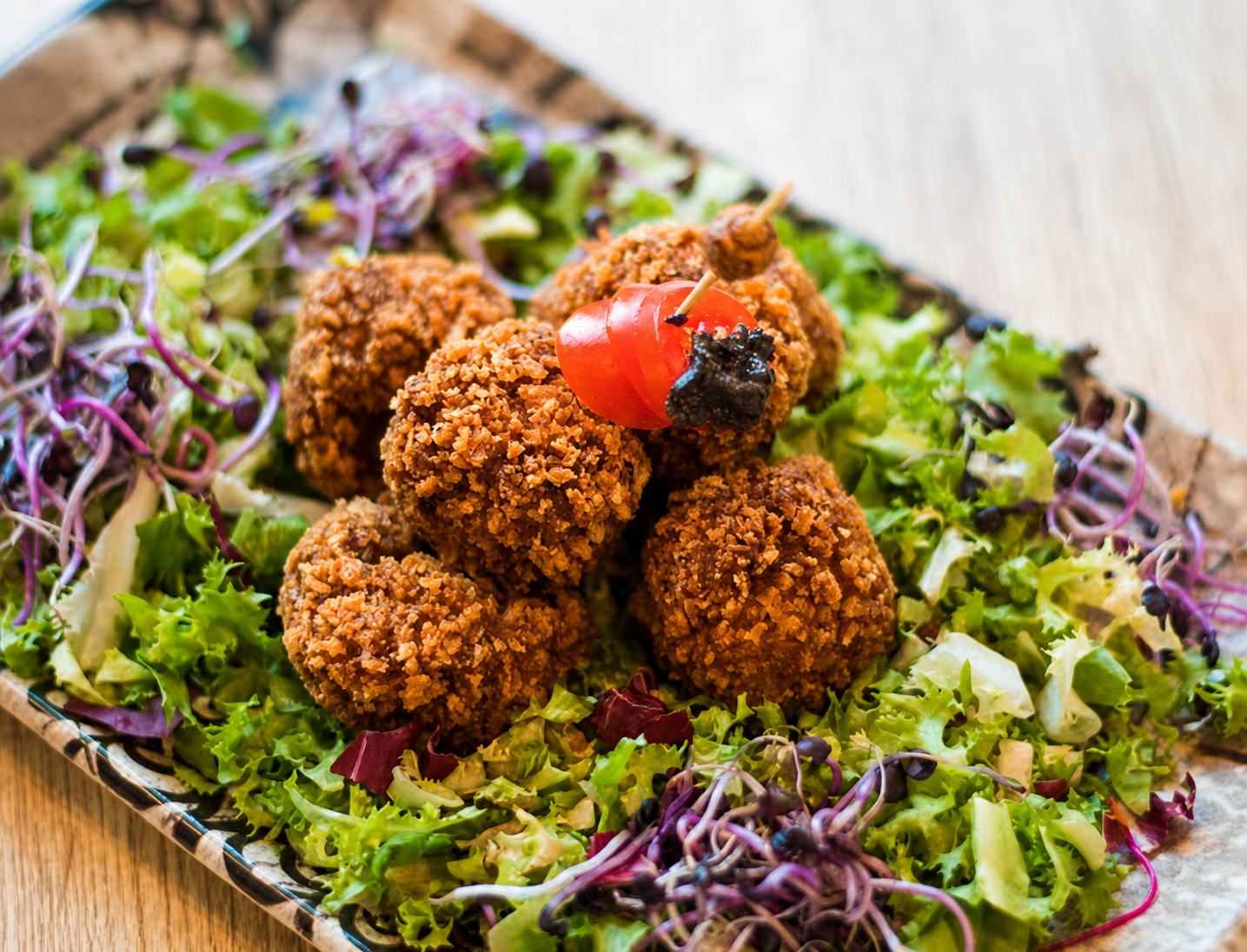
San Sebastián — Donostia in Basque — has more Michelin stars per square kilometre than any other city on earth. It also has more pintxo bars per square metre than almost anywhere in Spain. These two facts coexist without contradiction: this is a city where eating well is not a special occasion. It is the organizing principle of daily life, and the culture that produced Arzak, Mugaritz, and Akelarre also produced the €2 gilda on the bar at Bar Zeruko. The high end and the everyday are not in tension here. They are two expressions of the same obsession.
Breakfast: 8–10 AM
San Sebastián breakfasts at the bar. A café con leche and a pintxo de tortilla — a slice of tortilla española on a piece of bread — is the canonical first meal of the day. Any bar in the Parte Vieja (Old Town) will do this well. Bar Ganbara on Calle San Jerónimo opens early and does a particularly good tortilla.
For something more substantial: La Viña on Calle 31 de Agosto is famous for its Basque cheesecake — tarta de queso, burnt on top, soft and custardy inside. It’s acceptable to eat this for breakfast. The locals do.
Morning: the Bretxa market
Mercado de la Bretxa on Alameda del Boulevard is a two-level market: the ground floor is the modern retail hall, but the basement is where the serious food is. Fish from the Cantabrian coast — kokotxas (cod cheeks), turbots, whole merluza. Vegetables from the Basque interior. Pintxo ingredients at the stalls nearest the entrance. Go between 9 and 11 AM when the produce is freshest and the fishmongers are still busy.
The pintxo circuit: 12:30–2:30 PM
The midday pintxo circuit is the defining meal of San Sebastián. You move from bar to bar through the Parte Vieja, stopping for two or three pintxos and a txakoli (the local slightly sparkling white wine, poured from height to aerate it) at each one. Budget about €20 for a full circuit.
The essential stops:
- Bar Zeruko — innovative pintxos, beautifully presented. The gilda (olive, anchovy, guindilla pepper) is the classic Basque pintxo and this is one of the best versions in the city.
- La Cuchara de San Telmo — just off the main square, tiny, always packed. The pintxos here are more like small restaurant dishes: slow-cooked veal cheek, foie gras with apple, mushroom risotto bites. Order from the kitchen rather than taking from the bar.
- Bar Gandarias on Calle 31 de Agosto — for the txuleta sandwich (thick slices of grilled beef rib, nothing else). Also excellent anchovies.
- Bar Goiz Argi — famous for the prawn pintxo: a single large grilled prawn on bread with a sauce that people have been trying to replicate for thirty years. Arrive early; they run out.
The protocol: don’t take pintxos from the bar without ordering. Point at what you want, the bartender will plate it fresh. Pay as you go. Move on when you’re ready.
Lunch proper: 2–4 PM
If the pintxo circuit hasn’t been enough — and sometimes it has — a sit-down lunch is possible. Arzak in the Alto de Miracruz neighbourhood is three Michelin stars and 40 years of continuous innovation: Juan Mari Arzak started here in 1897 as his grandparents’ wine bar, and his daughter Elena now runs the kitchen. The tasting menu takes three hours and is one of the great meals in Europe. Book months ahead.
For something more accessible: Gandarias also has a restaurant section (separate from the bar) doing traditional Basque market cooking at reasonable prices. The fish of the day, simply grilled, is usually the move.
Afternoon: La Concha beach and a walk
The afternoon in San Sebastián belongs to the beach. La Concha is one of the most beautiful urban beaches in the world — a perfect crescent of sand in the middle of the city, backed by the old town and the hills of Monte Igueldo and Monte Urgull. Walk the promenade, have an ice cream, consider a swim. The water is cold but clean.
The mirador on top of Monte Urgull (accessible by foot, 20-minute climb) gives the best view of the city and the bay.
Evening pintxos and txakoli: 7–9 PM
The evening pintxo circuit is different from the midday one — more relaxed, more local, the bars starting to fill with people who work in the city rather than visit it. The Gros neighbourhood, across the Urumea river from the Parte Vieja, is less touristy and equally good: Bar Bergara and Bodega Donostiarra are the anchors.
Dinner: 9 PM onward
San Sebastián’s restaurant scene at the upper end is one of the densest concentrations of serious cooking anywhere. Mugaritz outside the city in Rentería is the most cerebral option — Andoni Aduriz’s kitchen is closer to a research lab than a restaurant, and the menu takes four hours. It is one of the most discussed restaurants in the world and deserves its reputation.
Within the city: Kokotxa on Calle del Campanario does exceptional Basque seafood without the tasting-menu format — à la carte, focused on the day’s catch, one of the most satisfying dinners in the city for a fraction of the Michelin-star price.
The thing to understand
San Sebastián is small — the Parte Vieja is walkable in twenty minutes — and the food is everywhere. The challenge is not finding something good to eat. The challenge is not eating too much, too early, and missing the thing you came for. Pace yourself. This is a city that rewards two or three days, not one.
Found a correction or an update?
Email us at hello@spainfoodguide.com — we keep our entries current.
Run a restaurant in Spain you think we should know?
Get featured →