
24 Hours Eating in Bilbao: A Pintxo and Basque Food Guide
You have one day in Bilbao. The city runs on food from 08:00 to well past midnight, and the rhythm matters more than any single restaurant. Start in a café where the walls have seen a hundred years of conversation. Cross the river to the biggest covered market in Europe. Order bacalao where it has been cooked the same way since the 1940s. Drink txakoli poured from a height. Eat pintxos standing up. Finish on a txuleta the size of a small chopping board.
This guide walks you through every stop, in order, with addresses, price ranges and the one dish to order at each place. It also covers the new 2026 Michelin updates if you want to swing upmarket. No hype, no filler. Just what a food-focused visitor actually eats in a day, the way locals do it.
The quick answer
Eating in Bilbao in 24 hours looks like this: coffee and tortilla at Plaza Nueva around 08:00, a market wander at Mercado de la Ribera by 10:30, lunch of bacalao al pil-pil at 13:30, a glass of txakoli in the late afternoon, a pintxo crawl across Casco Viejo from 19:30, and a txuleta steak dinner after 21:30. Budget roughly 90 to 140 euros for food and drinks across the day. Add a Michelin lunch at Nerua inside the Guggenheim if you want the fine dining layer.
08:00 coffee at Plaza Nueva
Start in the Casco Viejo, the old town east of the river. Plaza Nueva is a neoclassical arcaded square, quiet at this hour, with the shutters on the pintxo bars still half down. The café you want is Café Bar Bilbao at number six. It has been serving coffee and small plates since the early twentieth century. Tiled floors, marble counters, zinc fittings. Order a cortado and a wedge of tortilla de patata. The tortilla here is the onion-sweet, barely-set kind. Seven euros gets you both.
If you are in town on a Sunday, Plaza Nueva turns into a book and collectibles market from about 09:00. Old Basque cookbooks turn up on the stalls if you know where to look. Browse with a second coffee.
Want an even older room? Walk five minutes to Café Iruña on Calle Berastegi. The café has been trading for over a century, with neo-Mudéjar tiling, dark wood and a ceiling that feels cinematic before you have had breakfast. It is a calm place to plan the day.
Keep it light. You have a lot of eating ahead.
10:30 Mercado de la Ribera
Walk south along Calle Bidebarrieta, through the Plaza del Arenal, and you hit the river. The long art deco building on your left is Mercado de la Ribera. Its built area covers 10,000 square metres, which makes it the biggest covered market in Europe according to the city’s own tourism office and confirmed on the record since its 1929 construction. Stained glass windows, stepped façade, river views from the upper floor.
The ground floor is a proper working market. Fishmongers in the Basque tradition split whole merluza. Butchers hang lengths of txistorra sausage. Greengrocers pile guindilla peppers in glossy green pyramids. You do not need to buy anything. You need to watch the exchange between stallholder and shopper, because it tells you how Basque cooks choose their ingredients.
Then go upstairs to La Ribera Gastro Plaza, the food court added in 2015. Twenty-odd stalls serve pintxos, Galician oysters, cured Ibérico, grilled octopus, craft beer and txakoli. Order two things, not ten. A plate of Bellota ham and a glass of txakoli is a clean 12 euros for a mid-morning snack.
The market runs Monday to Friday from 08:00 to 14:00 and reopens 17:00 to 19:00, with Saturdays trading 08:00 to 14:30. Closed Sundays. Plan around it.
13:30 bacalao al pil-pil for lunch
Lunch in Bilbao is long and civilised. Basque people eat at 14:00 or later, so do not turn up before 13:30 unless you want to sit alone.
The dish to order is bacalao al pil-pil. Salt cod is soaked, then cooked slowly in olive oil with garlic and guindilla pepper, and the cook agitates the pan so the gelatin from the fish emulsifies the oil into a silky yellow sauce. It is one of the great technical dishes of Spanish cookery. Done well, it looks plain and tastes like the sea.
Two addresses stand out. Victor, in Plaza Nueva, has been cooking pil-pil on the same premises since the 1940s. Old guard service, starched napkins, no surprises on the menu. A full portion runs about 26 euros. Bar Bilbao next door does a pintxo-sized version on toast for under four euros if you want to keep moving.
If you prefer a modern dining room, book Trueba on Calle Pérez Galdós. The kitchen treats kokotxas (the gelatinous cod throat) with the same precision as pil-pil. Pair with a glass of Rioja Alavesa, not txakoli. Cod wants red.
Walk the meal off along the Nervión before the next stop. You need a break.
17:00 txakoli hour
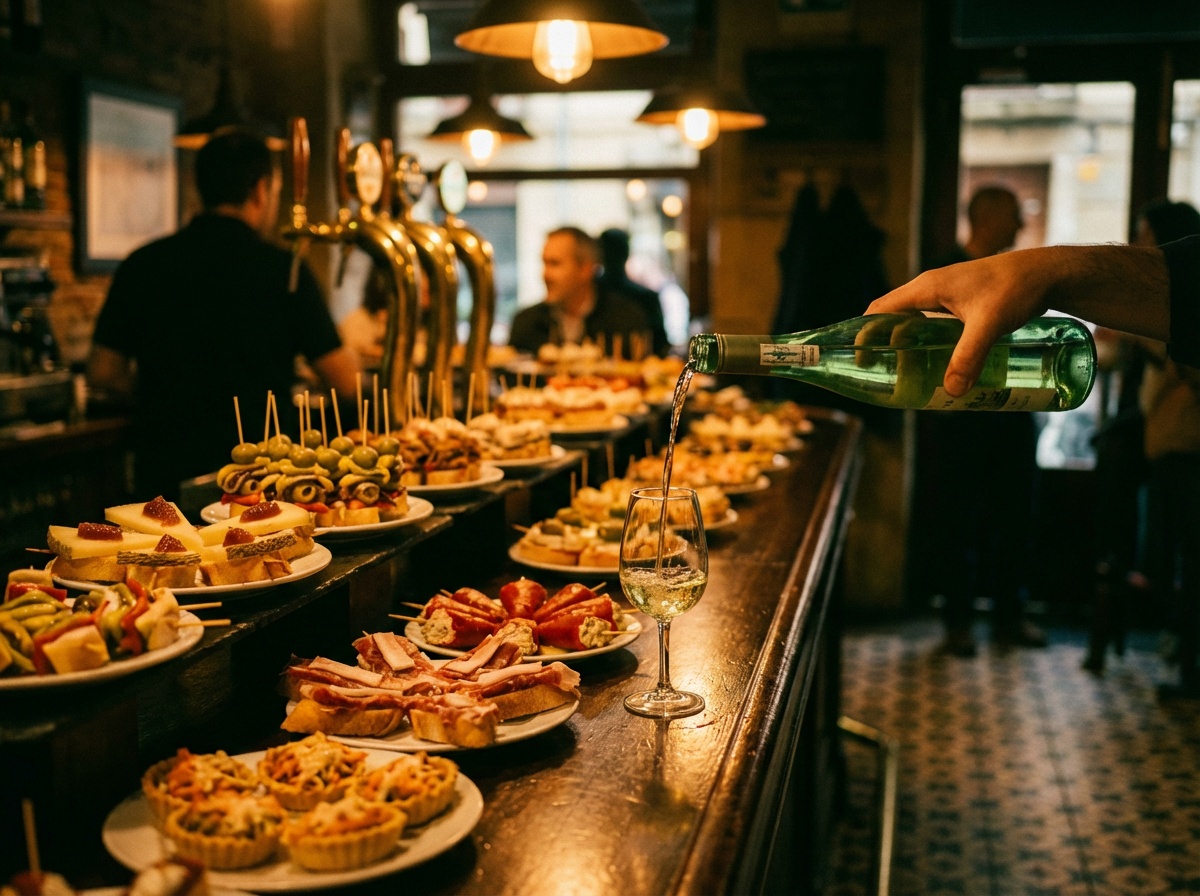
Txakoli is the white wine you came here for, even if you do not know it yet. It is made mainly from Hondarrabi Zuri grapes grown on coastal slopes, bottled young, low in alcohol at around 11 per cent, dry, saline, with a slight natural spritz. Servers pour it from a height, often half a metre above the glass, because the height aerates the wine and pulls out the prickle.
Order it at room temperature in a small tumbler, not a wine glass. The best low-key spot for txakoli hour is the terrace at Bar Charly on Plaza Nueva. The bar has been open since 1973, the owners know their pours, and three euros gets you a decent glass.
Pair it with boquerones en vinagre, white anchovies cured in vinegar and olive oil. Salt, acid, minerality, fat. It is the pairing the region was built on.
Sit for 20 minutes. Watch Plaza Nueva fill up. The crawl starts next.
19:30 the Casco Viejo pintxo crawl
Pintxos are Basque bar snacks served on or around bread, usually laid out on the counter for you to pick, or called from a blackboard. The crawl means you have one pintxo and one drink at each bar, then you move. Five bars in two hours is the right pace.
Stop one: Gure Toki, Plaza Nueva 12. Creative, award-winning kitchen. Order the Idiazabal cheese soup pintxo, which took first prize at the 2016 Bilbokatessen championship, or the duck pastrami with apple. Expect 3 to 5 euros per piece.
Stop two: Sorginzulo, Plaza Nueva 12. Two doors down, louder, younger crowd, fresher takes on tradition. The txangurro crab gratin on toast is the order. Eat standing, drink txakoli, leave the napkin on the floor because that is the etiquette here.
Stop three: Bar Charly, Plaza Nueva 8. Back to your txakoli spot for a second glass and a hot pintxo. The tuna and piquillo pepper brochette works. Cheap by Plaza Nueva standards, which matters when you are drinking all evening.
Stop four: Café Bar Bilbao, Plaza Nueva 6. Your morning café turns into a dense pintxo bar at night. Order the bacalao al pil-pil pintxo, a mini version of the lunch dish with an emulsion of the fish’s own gelatin.
Stop five: Gatz, Calle Santa María 10. Step off the square onto the old town’s narrow streets. Gatz has won the Basque Country pintxo championship multiple times. The braised oxtail on parmesan crisp is worth the walk.
A five-bar crawl costs around 35 to 45 euros including drinks. Pay at each bar before you leave. Cash is still easiest, though most places now take card.
21:30 txuleta for dinner
You will think you are full. You are not. The Basque Country runs on late dinners, and the dish to close with is txuleta: a huge bone-in rib chop from a mature, grass-fed cow, aged, seared hard on a flat plancha grill, sliced off the bone and served rare on a sizzling platter with flaky salt. No sauce. No sides beyond padrón peppers and maybe a tomato salad. The meat does the work.
For a classic room, book Asador Guetaria on Calle Colón de Larreátegui. Parrilla grill, white tablecloths, cider and Rioja. A txuleta for two runs around 65 euros per kilo, and two people share a one kilo cut.
For something more casual, head to Casa Rufo on Calle Hurtado de Amézaga, which doubles as a wine shop and a steakhouse. The txuleta comes from old dairy cows, deeply marbled, cooked in a room that smells of oak and char. Book ahead; it is small.
Finish with a glass of Pedro Ximénez sherry, not dessert. Walk it off beside the river.
The Michelin upgrade: Nerua, Azurmendi and the 2026 list
If you want a fine dining layer, slot in a long lunch at Nerua Guggenheim Bilbao. Chef Josean Alija, formerly of elBulli, holds one Michelin star, three Repsol Suns and a seat inside the Guggenheim museum itself. His Muina tasting menu runs through sea bass with saffron jus, wild mushrooms with acid, and Ibérico pancetta with pickled vegetables. Count on roughly 170 euros per head before wine. Book six weeks out.
Thirty minutes from the city centre in Larrabetzu, Eneko Atxa’s Azurmendi continues to hold three Michelin stars in 2026, confirmed on the Michelin Guide’s 2026 list. It is a destination lunch with a greenhouse welcome, foraged menus and a biodynamic winery attached. If you eat at only one three-star in the Basque Country, this is the one closest to Bilbao.
The 2026 Michelin Guide also added Islares, a new one-star in Bilbao built around seasonal produce and direct collaboration with local growers, according to the Guide’s official ceremony release. Worth booking if Nerua and Azurmendi are full.
If you prefer classic Basque fine dining in the city itself, Zortziko sits on Alameda de Mazarredo, a short walk from the Guggenheim, in an elegant Belle Époque townhouse. Chef Daniel García’s menu tilts traditional with modern technique. Expect 120 to 150 euros per head.
Worth noting for 2026: the wider Basque Country still holds 22 Michelin-starred restaurants, with four carrying three stars (Arzak, Akelarre, Martín Berasategui and Azurmendi) according to the Basque tourism office. Bilbao sits at the centre of that network, and any one of them is reachable as a day trip.
Common mistakes visitors make
Do not eat lunch at noon. Kitchens are often not open, and the ones that are cater to tourists. Wait until 13:30.
Do not order a flight of different pintxos at one bar. The point of the crawl is movement. One pintxo, one drink, next bar.
Do not keep the toothpick. Bars count them to price your bill, but in 2026 most have moved to ticketing or till counts, so just ask. Either way, eat the pintxo, do not stockpile plates.
Do not drink txakoli with red meat. It is a white, bright, saline wine. It belongs with anchovies, merluza, oysters and pintxos, not with txuleta.
FAQ
How do you spend one day eating in Bilbao?
Start with coffee and tortilla at Plaza Nueva around 08:00, wander Mercado de la Ribera at 10:30, have a long lunch of bacalao al pil-pil at 13:30, a glass of txakoli at 17:00, a five-bar pintxo crawl from 19:30 through Casco Viejo, and a shared txuleta steak dinner after 21:30. Budget 90 to 140 euros for food and drinks.
What are the best pintxo bars in Casco Viejo?
The Plaza Nueva square holds five of the best in a 50-metre radius: Gure Toki for creative, award-winning plates, Sorginzulo for modern riffs on classics, Bar Charly for affordable txakoli and hot pintxos, Café Bar Bilbao for traditional bacalao al pil-pil pintxos, and Gatz on Calle Santa María for championship-level oxtail and braised dishes.
Where can I try bacalao al pil-pil in Bilbao?
Victor in Plaza Nueva has been cooking the dish on the same premises since the 1940s and is the benchmark. Café Bar Bilbao serves a pintxo-sized version for under four euros. Trueba on Calle Pérez Galdós handles kokotxas and pil-pil with modern precision in a more formal dining room.
Is Mercado de la Ribera worth visiting?
Yes. Its 10,000 square metres make it the biggest covered market in Europe, and the upper floor gastro plaza added in 2015 is a working food court with 20 stalls serving pintxos, oysters and txakoli. Go on a weekday morning between 10:00 and 13:00 when both the stalls and the gastro plaza are busy. Closed Sundays.
Which Michelin starred restaurants are in Bilbao in 2026?
Nerua Guggenheim Bilbao holds one star under chef Josean Alija. The 2026 Michelin Guide added Islares as a new one-star in Bilbao focused on seasonal, locally-grown produce. Thirty minutes outside the city, Azurmendi in Larrabetzu retains its three stars. Zortziko, while not currently starred, remains one of the city’s classic fine dining rooms.
When should I eat pintxos in Bilbao?
The sweet spot is 19:30 to 22:00 on any evening, with Thursday to Saturday being busiest. Lunchtime pintxos (13:00 to 15:00) also work, but the evening crawl is the local rhythm. Counters get restocked at around 19:00 with fresh pintxos, so arriving then gives you the best selection.
How much does a day of eating cost in Bilbao?
Plan on 90 to 140 euros per person for coffee, market snack, a mid-range lunch of pil-pil, a txakoli hour, a five-bar pintxo crawl and a shared txuleta dinner with wine. Add 170 to 250 euros per head if you swap lunch for a Michelin-starred tasting menu at Nerua or Azurmendi.
Final note
Bilbao is not trying to impress you. It has fed itself this way for decades, and the food culture runs deep enough that you can show up, follow the rhythm, and eat brilliantly without booking anything fancy. Plaza Nueva in the morning. Mercado de la Ribera by lunch. Txakoli in the afternoon. A crawl at dusk. A txuleta at night.
Do that once, and you understand why the Basque Country has more Michelin stars per capita than almost anywhere in the world. The stars grow out of this everyday rhythm, not the other way around. Come hungry, stay late, and pour the wine from a height.
Found a correction or an update?
Email us at hello@spainfoodguide.com — we keep our entries current.
Run a restaurant in Spain you think we should know?
Get featured →